





A BI program can be delivered on time, on budget, to specification, and still fail on business intelligence adoption. Not visibly: the dashboards exist, the warehouse runs, the migration finished. It fails quietly, in the gap between what was built and who uses it.
Among the public sources we reviewed, the clearest estimate of that gap is broader than BI tool use. In a 2024 MIT CISR survey of 349 senior executives, respondents reported that on average only 28% of employees typically draw on reusable data assets. That is not a BI-platform adoption rate (in the briefing’s own example, employees reach such assets through a BI tool, a data view or an API), but it shows how much available data goes unused.
This piece covers what that number measures, how the research links it to returns (and what that link cannot prove), and how to measure BI adoption yourself: the share of eligible people who complete a defined, recurring decision in the governed BI workflow without help. If you are earlier than that (deciding what to build and in what order), settle those upstream decisions first, because adoption can only be measured once there is a governed workflow to measure it in.
The working rules here are written for mid-market organizations in the Benelux (roughly 50 to 249 employees, the EU’s medium-sized band); much of the research cited is international rather than Benelux-specific.
On this page
- What does adoption actually look like?
- How is adoption linked to the return?
- The four conditions in MIT CISR’s framework
- Should governance be centralised or federated?
- How do you prove it worked?
- An illustrative twelve-month sequence for one department
- Frequently asked questions
Key Takeaways
- Senior executives surveyed by MIT CISR estimated that on average 28% of employees typically draw on reusable data assets: a broader measure than BI tool use, and not based on usage logs.
- Where at least a third of employees use data assets, executives reported data monetization initiatives worth 15% of revenue, against under 5% elsewhere: an association, with one-third a grouping rather than a tested threshold.
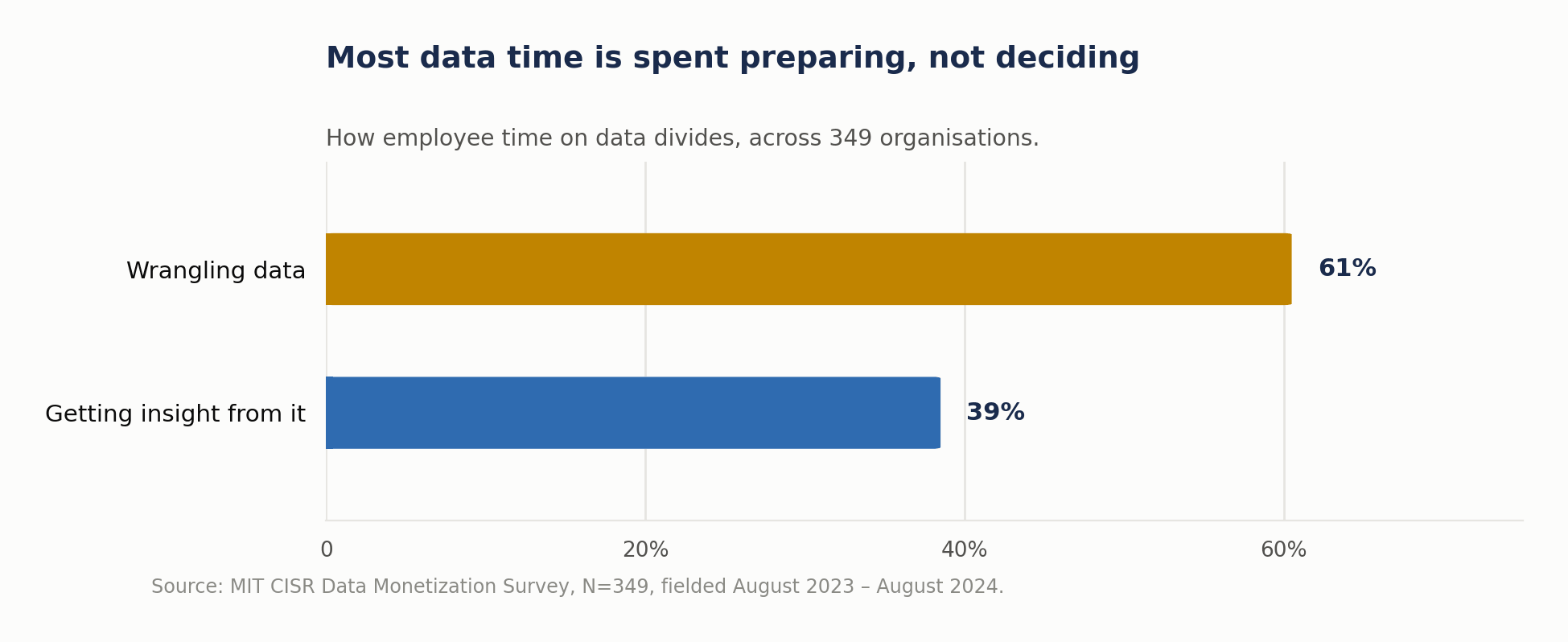
- In the same survey, executives put 61% of employees’ data time into wrangling data and 39% into getting insight from it.
- MIT CISR’s framework combines four conditions (access, skills, motivation, guidance) without measuring each one’s separate effect. Organizations reporting clear strategic guidance also reported 17% of revenue from data monetization, against 4% without it.
- In a Gartner survey of 223 D&A leaders, cultural resistance outweighed funding constraints as the primary reason governance initiatives fail, 60% to 40%.
- In a Gartner survey of 504 D&A leaders, only 22% of the organizations surveyed had defined, tracked and communicated business impact metrics for the bulk of their D&A use cases.
- None of the research cited here sets an adoption target; set yours from a local baseline.
What does adoption actually look like?
License counts measure provisioned access, not use.

The MIT CISR survey was answered by 349 senior executives with an overview of their organization’s enterprise-level data activities, distributed globally between August 2023 and August 2024. Two findings from the briefing are worth holding together: 28% of employees typically draw on reusable data assets, and the share of their data time spent wrangling data (61%) is larger than the share spent getting insight from it (39%).
Three cautions. These are executives’ estimates, not usage logs. The 28% is an average across organizations; the briefing does not publish the spread. And a data asset, in the briefing’s definition, is “a cohesive set of data that is made readily usable”, which covers more than BI tool use.
Four different numbers tend to get mixed up in this debate:
| Measure | What it counts | Where a figure comes from |
|---|---|---|
| BI tool adoption | Eligible people using the BI environment for a defined task | Your own telemetry; no source cited here offers a benchmark |
| Data asset use | Employees who typically draw on reusable data assets, by any route | MIT CISR: 28%, executive estimate |
| Enterprise analytics or BI prevalence | Whether an enterprise analyses data, or uses BI software, at all | Eurostat: 33.02% analyze data in-house; 16.28% use BI software |
| Business impact | Better decisions, lower cost or risk, against a baseline | Gartner: 22% track impact metrics for most use cases |
MIT CISR presents the 61/39 split as a symptom of access friction: finding, permissioning, provisioning, preparing and integrating data before anyone can use it. If most data time goes into making data usable, few people get as far as a decision. So investigate access and preparation before blaming the interface, without ruling out usability or workflow design as the main barrier in your case.
Eurostat measures whether an enterprise performs data analytics at all. In 2025, 33.02% of EU enterprises with at least ten employees and self-employed persons (finance excluded) analyzed data with their own staff (78.84% of large enterprises, 27.86% of small), 13.85% used an external provider and 16.28% used BI software. Counting either route, shares ranged from 59.99% in Denmark and 55.96% in the Netherlands to 24.50% in Poland. That is market context, not an employee-adoption benchmark.
One caution, because this subject is full of laundered statistics. As of 3 October 2026, we could not trace the widely repeated claims that 70–80% of BI projects fail, or that a set share of BI seats goes unused, to a primary source, and we found no citable dashboard abandonment statistic. The 28% at least comes with a named sample and a fielding window.
How is adoption linked to the return?
MIT CISR reports a group difference, with one-third of employees as the dividing line, not far above the survey average. The briefing does not say why one-third was chosen or whether other cut-offs were tested, so read it as a grouping, not a threshold.
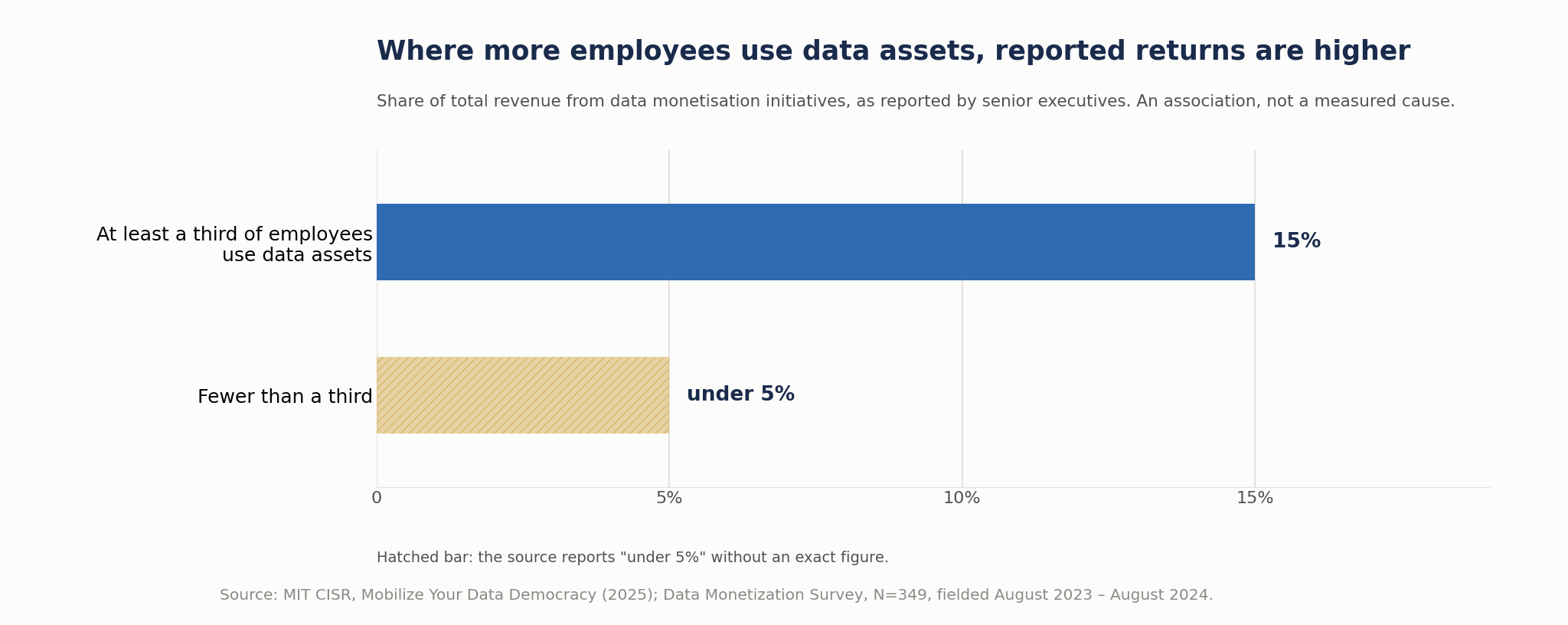
MIT CISR found that in organizations where at least one-third of employees use data assets, data monetization initiatives account for 15% of total revenues; where use is lower, the figure is under 5%.
Read those figures carefully. The authors put it causally: “it is data asset use that drives financial returns”, but the evidence is one cross-sectional survey in which senior executives estimate both the usage share and the revenue share for their own organization. That shows the two move together. It cannot rule out the reverse (organizations already earning from data spread it further) or a common cause such as overall data maturity.
For an organization exactly at the 28% average, one-third is about five percentage points away: roughly 53 people per 1,000 employees. That is arithmetic, not a target. Your starting point may differ, not every employee is an eligible user, and the survey does not show that crossing the line changes revenue. Treat the link as a hypothesis to test in one department.
Adjacent evidence from AI programs points the same way. In an April 2026 release based on a survey of 353 data, analytics and AI leaders, Gartner reported that organizations reporting successful AI initiatives invest up to four times more, as a percentage of revenue, in foundational areas such as data quality, governance, AI-ready people and change management than those with poor AI outcomes. That is evidence about AI foundations, not about BI adoption or platform choice.
The four conditions in MIT CISR’s framework
MIT CISR’s framework for what it calls a data democracy names four conditions: access to data assets, the skills to exploit them, the motivation to engage with them, and guidance to use them strategically. The briefing defines a data democracy by all four and calls access necessary but not sufficient; it does not estimate a separate effect for each.
MIT CISR treats them as joint requirements: access, for example, is necessary but not sufficient.
Guidance is the only condition the briefing ties to a revenue figure: 17% vs 4% of revenue, a reported association.
Conceptual framework, not a data chart.
| Condition | What it looks like in practice (our reading) | How it can fail (our view) |
|---|---|---|
| Access | People can reach the data assets relevant to their work without asking someone | Access requests route through a queue nobody owns |
| Skills | They can do something useful with them once they arrive | Training happened at go-live, for people who have since left |
| Motivation | There is a reason to engage rather than use the old workaround | The spreadsheet is still accepted in the meeting |
| Guidance | They know which questions are worth asking | No one has said what the organization is trying to decide faster |
The fourth is the only condition the briefing attaches a revenue figure to: organizations reporting clear strategic guidance also reported more than four times the revenue share from data monetization, 17% against 4%. It is the same kind of association as above, and the briefing compares neither effects nor costs across the four. In our view guidance is often a low-cash-cost start, because naming the decisions that matter is mostly leadership time, though agreeing priorities can be hard.
MIT CISR lists monitoring use, incentives and visible leadership signaling as motivation practices. In our view motivation is also a process problem. People keep using a spreadsheet not because they are unaware of the dashboard but because the spreadsheet is still accepted: in the meeting, in the report that goes upward. As long as both are accepted, the familiar one tends to win. Retiring the workaround is often the stronger lever, but only once the replacement has earned it: figures reconcile with the old route within agreed tolerances, the people who need it have access, exceptions have a handling path, someone owns support, and a way back has been tested. Training works best when the new workflow is trusted and expected.
Skills decay through turnover, infrequent use and workflows that change after launch. Turnover is the most structural: training is often delivered at go-live to the people present, and their replacements are onboarded onto documented systems that may not include the analytics layer. MIT CISR adds that direct application builds practical skills better than large-scale literacy training. Treating enablement as an intake process rather than a launch event costs little.
MIT CISR also names five connecting structures that carry these practices into an organization, and pairs each with the condition it supports best. The right-hand column is our reading, not the briefing’s:
| Structure | What MIT CISR links it to | Where it can struggle (our view) |
|---|---|---|
| Enterprise services | Access: centrally managed, scaled access to data assets | Says little about whether anyone knows what to ask |
| Social networks (e.g. communities of practice) | Access: peer-to-peer sharing about which data assets exist and how to use them | Invisible to planning, so often unresourced |
| Cross-functional teams | Skills: learning by doing, with domain and data experts together | Hard to sustain once the initiating project ends |
| Embedded experts | Motivation: coaching and mentoring colleagues inside a unit | Expensive per head; covers one function at a time |
| Center of excellence | Guidance: standards, strategy and a common direction | Can become a queue that everything has to pass through |
For a mid-market organization starting in one function, one workable pattern, in our view, is an embedded expert in that function with an enterprise service underneath and the center of excellence deferred. Bring the center of excellence forward when several functions need common standards, regulated controls or shared enablement; company size alone is a poor trigger.
Should governance be centralized or federated?
Gartner’s answer is that a binary choice is the wrong framing: centralize some responsibilities and distribute others. It is worth knowing before a reorganisation is proposed in its name.
At its Orlando summit in March 2026, VP Analyst Jorg Heizenberg put it directly: “D&A leaders should avoid choosing between centralization or decentralization; instead, they should adopt both”. The five governance best practices Director Analyst Anurag Raj presented in London in May 2026, among them an integrated governance operating model and diversified and dynamic stewardship, do not prescribe a single organisational model either.
Peer-reviewed evidence from a neighboring setting adds nuance. A 2025 study of four German data ecosystems (networks that share data between organizations, not governance inside one company; 25 interviews) found large ecosystems shifting toward centralized governance as they matured, while specialized ones preserved autonomy.
For a mid-market organization our working rule is a default, not a universal law: centralize the definitions and the data foundation, federate the analysis and the dashboards within guardrails.
| Centralize | Federate, within those guardrails | Keep an explicit approval path |
|---|---|---|
| Shared metric definitions and the semantic layer | Exploration and analysis in the domain | Publishing to production and executive reporting |
| Access policies and security controls | Dashboards for the domain’s own decisions | Regulated and external reporting |
| Core data products and quality rules | Domain metrics that do not redefine shared ones | Changes to shared definitions |
One team owns what a customer is; any team can ask questions about customers. Where a domain lacks the skills or quality controls to run its own analysis, keep more of it central until it has them.
There is a warning attached. A Gartner survey of 223 data and analytics leaders in March 2026, published in September, found that cultural resistance outweighs funding constraints as the primary reason governance initiatives fail: 60% against 40%. Anurag Raj put it plainly: “Data governance without a focus on a data-driven culture is an effort in vain.” Separately, a session summary from Gartner’s Orlando summit states, without a sample, that only 26% of organizations incorporate culture and communication into their D&A governance strategy. They come from different sources and questions, so they are not one estimate, but together they suggest culture needs a named place in the governance plan.
As of 3 October 2026, we could not find a published, sourced distribution of how many organizations use each governance model. If you are shown a percentage split for centralized versus federated versus hub-and-spoke, ask for the survey behind it.
How do you prove it worked?
Few surveyed organizations measure it comprehensively. Of the 504 data and analytics executive leaders Gartner surveyed between September and November 2024, only 22% had defined, tracked and communicated business impact metrics for the bulk of their D&A use cases, while 30% of chief data and analytics officers named the inability to measure impact as their top challenge. The rest may measure some use cases; comprehensive measurement is what is rare. Senior Director Analyst Michael Gabbard’s characterization is worth putting in front of a steering group: “There is a massive value vibe around data, where many organizations talk about the value of data, desire to be data-driven, etc., but there are few who can substantiate it.”
The fix is unglamorous: define the test before the build, and make it behavioral rather than perceptual. MIT CISR’s own first recommended step is the same idea: establish a baseline of data asset use before investing further.
Start with the denominator. For each recurring decision, name the eligible cohort (who is expected to make it), the action that counts as completing it in the governed workflow (approving a discount in the system, not opening the dashboard), a window matched to how often the decision comes round, and exclusions such as the delivery team. Adoption is eligible people who completed the action unaided in the window, divided by all eligible people; repeat use is the same count over two consecutive windows. Illustration only: if 80 account managers are expected to approve discounts in a quarter and 44 do so unaided in the governed workflow, adoption is 55%; if 36 do it again next quarter, repeat use is 45%.
Then measure in layers. The early ones are diagnostic; only the later ones say anything about value:
| Layer | Example measure | What it can and cannot tell you |
|---|---|---|
| Reach | Licenses issued; eligible people with access | Whether people could use it, not whether they do |
| Activation | First meaningful action by an eligible person | Whether onboarding works; views alone may mean curiosity or a broken bookmark |
| Repeat use | The same person completing the action in consecutive windows | Whether the workflow has stuck |
| Decision | Cycle time for the named decision; manual workaround retired | Whether the decision now runs through the system |
| Outcome | Errors, rework, margin or risk against a baseline | Whether decisions got better, not only faster; hardest to attribute |
Satisfaction scores and reports delivered fit no layer well; reports retired because something better replaced them tell you more. Combine platform telemetry, an eligible-user roster and workflow evidence, with one person reconciling them. A decision the system confirms can be as good an outcome as one it changes. Record other process changes that could explain a difference.
The last two layers are harder to collect, which is why an organization that has them holds an argument that is hard to dismiss at budget time.
An illustrative twelve-month sequence for one department
The sequencing decision that matters most is scope. Start with one function as a controlled pilot and set its target from a local baseline and an eligible-user denominator, not from the 28% cross-organization average or the one-third grouping. Going organization-wide in a quarter is how programs end up reporting license counts.
This is a planning example, not a market benchmark. It assumes one priority data domain, an executive owner, a domain owner and some analyst capacity; adjust it to data readiness and controls, and move on when a gate is met, not when the calendar says so.
| Months | Focus | Gate to move on |
|---|---|---|
| 1–2 | Baseline and guidance | Priority decisions named with owners; eligible cohort, current rate and cycle time recorded for one to three of them; the value test written down before anything is built |
| 3–4 | Definitions | An agreed set of core metric definitions, signed off by the functions that argue about them |
| 5–7 | Access | One trustworthy data domain reachable without a request queue |
| 8–10 | Skills and motivation | Training for the people who will actually use it; the old workaround retired once reconciliation, access, exception handling and a tested rollback are signed off |
| 11–12 | Proof | The value test run and reported against the baseline; the next department chosen on evidence |
The sequence borrows MIT CISR’s four steps (baseline, gaps, connecting structures, measure and iterate), but the briefing prescribes no order for the four conditions. The middle months assume the baseline points to guidance and access; if it points to skills or motivation, reorder them. In our view guidance is often a low-cash-cost start and access often the most expensive to fix, and retiring the accepted workaround, once it has passed those checks, is likely to do more for adoption than further enablement, because the alternative stops being free.
Frequently asked questions
What is a realistic adoption target?
None of the research cited here sets one. MIT CISR’s 28% is an executive-estimated average for reusable data assets, and its one-third line is a grouping in one survey. Set yours from your baseline, the people expected to make the decision and how often they make it; a department-level target tested over a year is more credible than a company-wide number.
How do we measure adoption without counting licenses?
Use the decision-based measure above: eligible people outside the delivery team who complete a recurring decision in the governed workflow without analyst help, over a window matched to its cadence. It is usually stricter than views or logins, because it requires a named task, an eligible user and unaided completion.
Which of the four conditions should we fix first?
Let the baseline decide. A short guidance exercise, naming the decisions that matter and who makes them, exposes the gaps, and guidance is the only condition MIT CISR ties to a revenue figure (an association, not a proven effect). But if access is blocked or the core data is wrong, that gap needs the first real investment.
Do we need a data governance council?
You need agreed definitions and someone who can arbitrate when two functions disagree; whether that is a council or a named individual depends on your size. Either way, give culture a named place: in Gartner’s March 2026 survey of 223 D&A leaders, cultural resistance outweighed funding constraints as the primary reason governance initiatives fail.
Our dashboards exist but nobody opens them. Where do we start?
Find out why people went back to their spreadsheets before changing anything. Test the likely causes one at a time: numbers that do not reconcile with a source people trust, unclear definitions, a workflow that still ends in the spreadsheet, and poor usability. Low view counts alone will not tell you which. Our guide to dashboard design covers the design half once the trust half is settled.
What moves the number
Adoption is treated as the soft end of a BI program and measured last. One executive survey associates wider use of reusable data assets with higher reported revenue from data monetization; it cannot show how much extra use would change the accounts in a given organization, or which way the effect runs.
That still leaves plenty to act on: a measure of use built on eligible people and a named decision, a diagnosis of which condition is missing, a workaround retired only once its replacement is trusted, and governance that gives culture a place. None of these is solved by platform choice alone, though access, reliability and instrumentation depend on the platform too. Set the operating model’s requirements before a platform is chosen or expanded.
Before committing to a roadmap, it helps to know who uses which data today, and where the gaps are. Our Discovery engagement is a two-to-four-week current state and gap assessment that ends in a roadmap with prioritized steps.
Related Articles
- BI Strategy & Roadmap: A Complete Guide for Dutch Mid-Market Companies — Frameworks, roadmaps and tools to turn data into decisions
- Building a KPI Dashboard: From Data to Insight — From data to a working KPI dashboard, step by step
Sources
Academic and research centre
- MIT Center for Information Systems Research, Mobilize Your Data Democracy, Research Briefing XXV-9, van der Meulen, Someh, Wixom & Beath, 18 September 2025. Based on the 2024 MIT CISR Data Monetization: Generating Financial Returns from Data and Analytics Survey (N=349), distributed globally August 2023 – August 2024 to senior executives with an understanding of their organisation’s enterprise-level data activities and outcomes. The figures are executive estimates, not BI platform telemetry; the briefing defines a data asset as a cohesive set of data made readily usable.
- Kernstock, Harms, Hein & Krcmar, Establishing and governing data ecosystems at the crossroads of centralization and decentralization, Electronic Markets 35, article 71, published 21 July 2025. Exploratory case study of four German data ecosystems; 25 semi-structured interviews, July 2023 – August 2024.
Analyst
- Gartner, Gartner Survey Finds One-Third of CDAOs Cite Measuring Data, Analytics and AI Impact as Top Challenge, 20 February 2025. Survey of 504 D&A executive leaders, fielded September–November 2024.
- Gartner, Gartner Predicts 60% of Organizations That Ignore Data Governance Culture Challenges Will Fail to Govern AI Successfully by 2027, 21 September 2026. Survey of 223 D&A leaders, March 2026.
- Gartner, Organizations with Successful AI Initiatives Invest Up to Four Times More in Data and Analytics Foundations, 16 April 2026. Survey of 353 D&A and AI leaders, November–December 2025.
- Gartner, Data & Analytics Summit Orlando 2026, Day 1 highlights, 9 March 2026 (Heizenberg quotation; the 26% culture and communication figure is from the summary of the session 7 Practical Ways to Improve Data Governance Today, which gives no sample), and London 2026, Day 2 highlights, 12 May 2026 (five governance best practices).
Official statistics
- Eurostat, Digital economy and society statistics: enterprises, reference year 2025, data extracted January 2026. Covers enterprises with at least ten employees and self-employed persons in Statistical Classification of Economic Activities in the European Community (NACE) Rev. 2 sections C to N, excluding section K (financial and insurance activities) and division 75, plus group 95.1. Country figures refer to analytics performed by own employees or an external provider.