




Hiring a Logistics Consultant: A Complete Hiring Guide for Benelux Mid-Market
A logistics consultant diagnoses and restructures supply chain, warehousing, and transport operations to reduce cost, improve service levels, and increase working capital efficiency. Dutch transport sector revenue grew 4.4% in 2025 — yet 82% of logistics managers plan further automation investment within three years, signalling that revenue growth alone does not resolve structural inefficiency.
This logistics consultant hiring guide gives Benelux mid-market companies a practical decision framework for hiring, briefing, and measuring a logistics consultant — without paying for advice reports that gather dust.
You will learn: what a logistics consultant actually costs, how to structure the engagement for measurable ROI, and when not to hire one.
Table of Contents
- Why This Matters Now
- What a Logistics Consultant Actually Does
- The Chain-to-Cash Compass: A Decision Framework
- Costs, Contracts, and ROI Benchmarks
- When Not to Hire a Logistics Consultant
- How to Run the Selection Process
Why This Matters Now
The Benelux logistics sector is at a structural inflection point. Warehouse automation payback periods have dropped from 5.2 to 3.1 years. AI adoption among Dutch businesses jumped from 23% to 33% in a single year. Twenty-five percent of transport companies cite labour shortage as their primary production constraint. Companies that delay structured improvement programmes face compounding cost disadvantage.
CBS data shows Dutch businesses invested €35.5 billion in ICT in 2024 — 15.5% of total national investment, up 4.2% year-on-year. The logistics sector absorbed a disproportionate share, driven by Transport Management Systems, demand forecasting tools, and warehouse robotics.
CBS confirms that road transport productivity rose 5% in 2024 through better load factors and fewer empty kilometres — gains delivered specifically by digital planning tools. Companies without those tools now operate at a structural cost disadvantage versus peers who invested two years earlier.
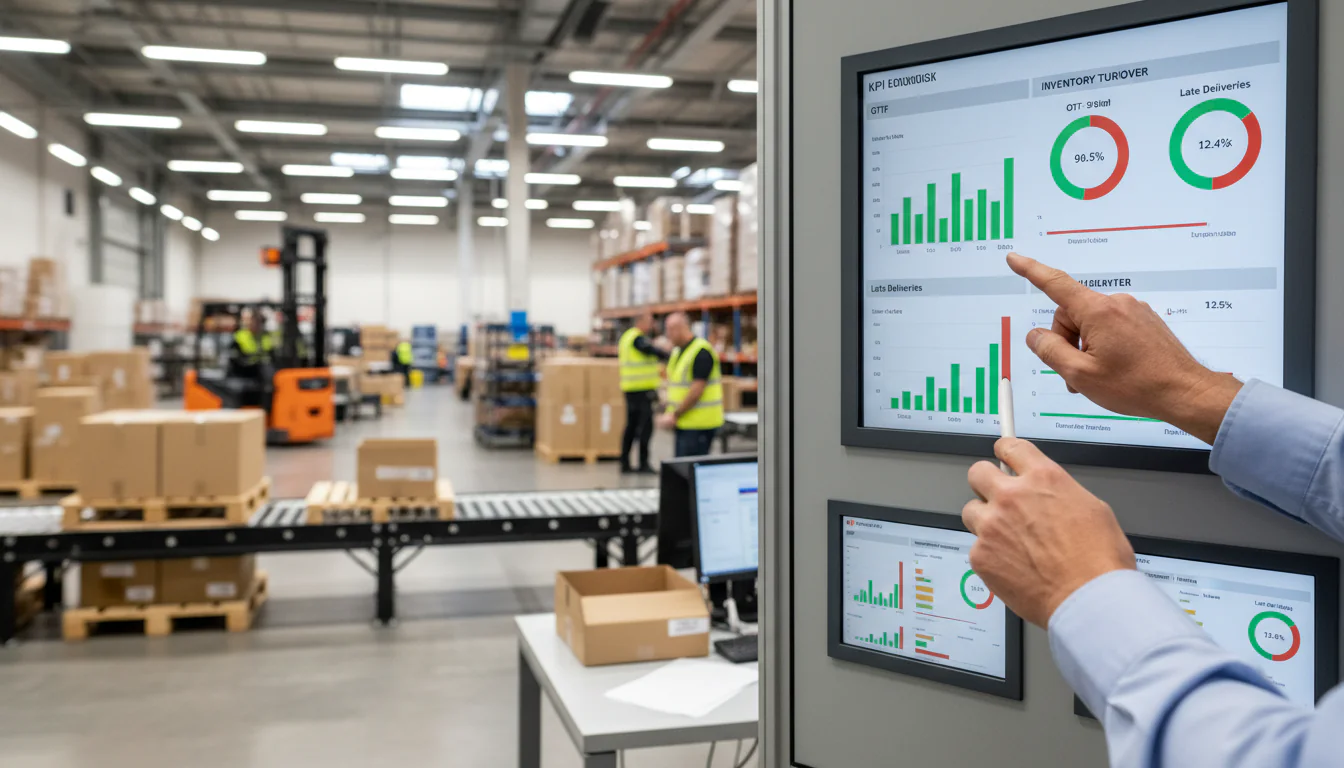
In Flanders, the gap is equally stark. Only 34% of SMEs in manufacturing and logistics have implemented a formal data strategy, despite 68% acknowledging that data-driven optimisation is critical for international competitiveness, according to Vlaio research.
Key market pressures driving demand for logistics consulting right now:
- Labour scarcity: 25% of Dutch transport and storage companies cite personnel shortage as their primary production constraint (CBS)
- Automation urgency: Payback on warehouse automation has fallen from 5.2 to 3.1 years, per McKinsey data cited by Topsector Logistiek
- Regulatory cost: EU emissions regulations are accelerating fleet transition costs across the Benelux
- Data gap: Gartner’s 2025 supply chain technology priorities include agentic AI and augmented connected workforce — capabilities most mid-market companies cannot build without external expertise
Source: CBS, 2026
What a Logistics Consultant Actually Does
A logistics consultant delivers quantified operational improvement across four domains: network design, inventory optimisation, process re-engineering, and technology selection. The distinction from a general management consultant is specificity — a logistics specialist names your bottleneck in week one, not month three. AI-driven demand forecasting alone improves forecast accuracy by an average of 35%, reducing inventory surplus by 20–30%, per McKinsey Supply Chain research.
Scope varies enormously by engagement type. A network redesign for a €40M Dutch industrial distributor in Tilburg looks nothing like a warehouse process audit for a €15M Flemish e-commerce operator. What does not vary is the output expectation: measurable change in cost-per-order, service levels, or working capital within a defined timeframe.
Typical engagement types and their outputs:
| Engagement Type | Duration | Primary Output | Typical ROI Horizon |
|---|---|---|---|
| Bottleneck Diagnostic | 2–4 weeks | Ranked constraint list with € impact | Immediate (informs next step) |
| Inventory Optimisation | 6–12 weeks | Reduced days-on-hand, safety stock model | 3–6 months |
| Warehouse Process Redesign | 8–16 weeks | Layout, flow, and staffing model | 6–12 months |
| Network Redesign | 3–6 months | DC footprint, carrier mix, cost model | 12–24 months |
| Technology Selection & Implementation | 3–9 months | TMS/WMS live, KPI baseline established | 12–18 months |
Hiring for the wrong scope is expensive. A company with a forecasting problem does not need a network redesign. A company with a carrier cost problem does not need a new WMS. The diagnostic phase — typically 2–4 weeks — should always precede any larger commitment.
What separates a strong logistics consultant from a generalist is the ability to quantify the bottleneck before proposing a solution. Ask any candidate: “What is the €-impact of our top constraint?” If they cannot answer that in week two, the engagement is already off track.
For companies assessing how operational intelligence tools can accelerate this diagnostic, Veralytiq’s Operational Intelligence solutions provide the data layer that makes bottleneck identification faster and more defensible.
The Chain-to-Cash Compass: A Decision Framework
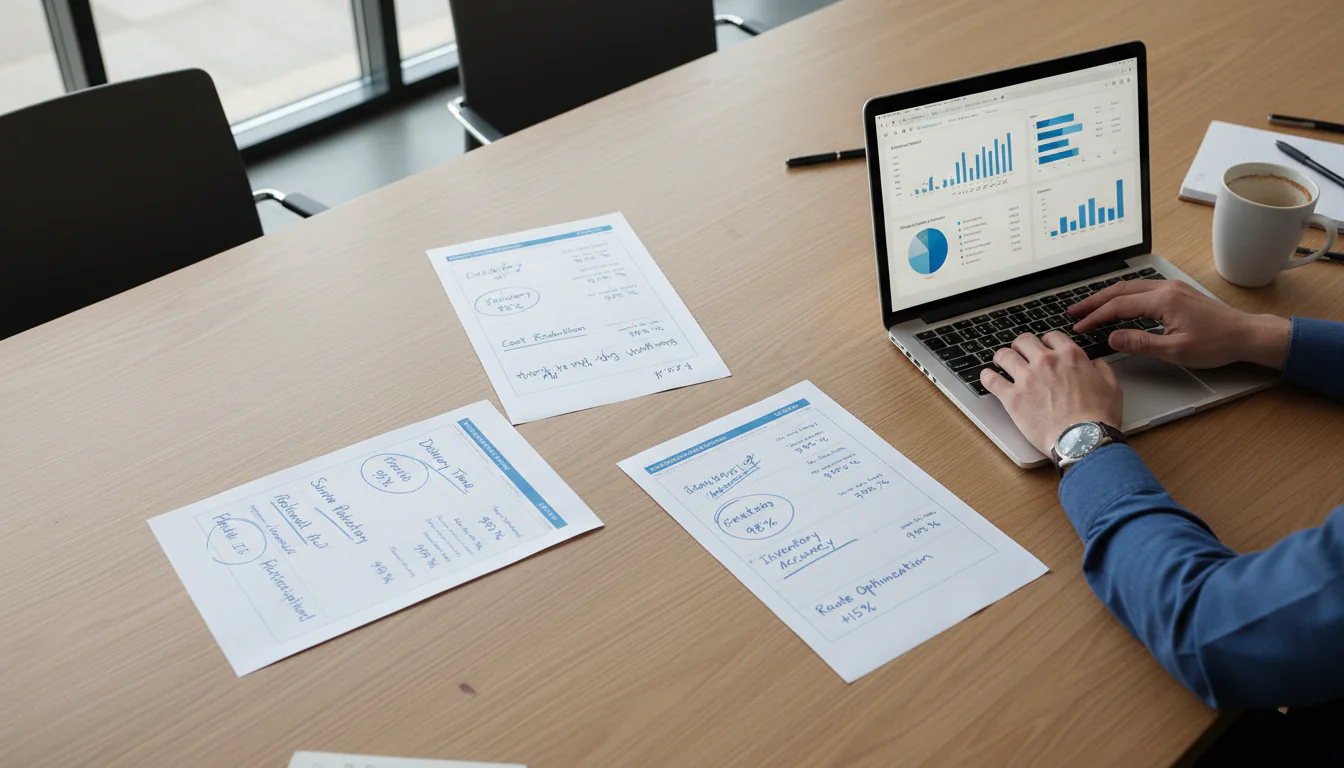
The Chain-to-Cash Compass is a four-step decision framework for Benelux mid-market companies (€10M–€50M revenue). It structures a logistics consulting engagement around measurable value drivers — service level, cash, and cost — and produces a CFO-ready business case within the first two weeks. It prevents the most expensive failure mode: hiring without a defined value anchor.
Step 1: Choose Your Value Anchor
Before issuing a brief, your leadership team must agree on one primary value driver. Three options:
- Service: OTIF rate, delivery lead time, customer complaint rate
- Cash: Days inventory outstanding, working capital tied in stock
- Cost: Logistics cost per order, cost per km, warehouse cost per pallet
Define three KPIs as your “North Star.” A €30M building materials distributor in Ghent, for example, might choose Cash as anchor with KPIs of: days-on-hand ≤18, safety stock value ≤€1.2M, and working capital release target of €400K within 12 months.
Step 2: Run a Bottleneck Scan Across Four Nodes
A credible logistics consultant completes a quantified bottleneck scan within two weeks. The four nodes to measure:
- Forecast → Plan: Is demand signal accurate enough to drive procurement?
- Plan → Make/Buy: Are purchase orders and production schedules aligned to actual demand?
- Make/Move → Warehouse: Where does dwell time accumulate before goods reach storage?
- Warehouse → Deliver/Return: What is the cost and time profile of the last mile?
The output is a ranked “Top 5 Constraints” list with a € impact per constraint. This list becomes the consulting brief. No constraints list, no engagement.
Step 3: Assess Data and Tool Fit
Sixty minutes with your ERP, planning tool, and Power BI environment tells an experienced consultant whether the problem is a data problem, a process problem, or a technology problem. These are different problems with different solutions and different costs.
Step 4: Build the Business Case
With constraints quantified and tool fit assessed, the consultant produces a one-page business case: investment required, expected € benefit, payback period, and risk factors. For warehouse automation specifically, payback periods now average 12–24 months for targeted implementations — down from five-plus years a decade ago.
Source: McKinsey / Topsector Logistiek, 2026
For a deeper look at how automation fits into the wider logistics evolution, see Supply Chain 4.0: The Future of Automated Chains.
Costs, Contracts, and ROI Benchmarks
A logistics consulting engagement for a Benelux mid-market company typically costs €15,000–€80,000 for a diagnostic-to-recommendation phase, and €60,000–€250,000 for a full implementation programme. Day rates for experienced logistics consultants range from €900–€1,800 depending on seniority and specialisation. Targeted interventions deliver 3:1 to 6:1 ROI within 18 months.
Most companies overpay for diagnostics and underpay for implementation support. A 12-week “strategy report” at €120K that produces a presentation is not the same as an 8-week bottleneck-to-fix engagement at €60K that moves KPIs. Contract for outputs, not hours.
What Does a Typical Engagement Cost?
| Phase | Duration | Typical Cost Range | Output |
|---|---|---|---|
| Diagnostic / Bottleneck Scan | 2–4 weeks | €8,000–€25,000 | Constraint list with € impact |
| Concept Design | 4–8 weeks | €15,000–€45,000 | Solution blueprint + business case |
| Implementation Support | 8–24 weeks | €40,000–€180,000 | Live process/system change |
| Ongoing Optimisation | Monthly retainer | €3,000–€8,000/month | KPI monitoring + iteration |
Contract Structures to Consider
Three contract models are common in the Benelux market:
- Fixed-fee per phase: Cleanest for budget control. Risk sits with the consultant.
- Time-and-materials with cap: Flexible for complex scopes. Requires active management.
- Success fee component: 10–20% of fees tied to KPI achievement. Aligns incentives but requires baseline agreement upfront.
The success fee model is underused. A logistics consultant confident in their methodology will accept a partial success fee. If they refuse entirely, ask why.
Subsidy Opportunities
Dutch companies should check WBSO eligibility for technology implementation projects with an R&D component. The MIT scheme supports collaborative innovation projects — including logistics digitisation — with subsidies up to €350,000 for SMEs. In Flanders, Vlaio’s KMO-Portfolio scheme provides up to 30% subsidy on consulting fees for recognised advisors, directly applicable to logistics consulting engagements.
For companies assessing how data infrastructure underpins these investments, Veralytiq’s Data Foundation service provides the measurement layer that makes subsidy applications and ROI tracking defensible.
When Not to Hire a Logistics Consultant
Forty percent of logistics consulting engagements in the mid-market fail to deliver their stated ROI. The failure modes are predictable — and avoidable. Before issuing a brief, check your situation against these four disqualifying conditions. Each one signals that a different intervention will deliver more value than external consulting.
Here are four situations where hiring a logistics consultant is the wrong next step:

- Your data is not reliable enough to diagnose. If your ERP shows inventory figures that your warehouse team does not trust, a consultant will spend 60% of their time reconciling data rather than solving problems. Fix the data layer first. See what AI solutions require from your data foundation before engaging external logistics expertise.
- You have not aligned on the value anchor internally. If your CFO wants cost reduction and your operations director wants service improvement, a consultant will be caught in the middle. Resolve the internal priority before spending on external advice.
- The problem is a people problem, not a process problem. No process redesign fixes a team that lacks the capability or motivation to execute. If your logistics team has not changed a single process in three years, the constraint is management, not methodology.
- You are looking for validation, not diagnosis. Some companies hire a consultant to confirm a decision already made. That is expensive validation. If you already know the answer, implement it.
Companies with the highest ROI from consulting treat the engagement as a short-term expertise transfer — a way to compress a 12-month learning curve into 8 weeks. The goal is always to build internal competence, not dependency.
How to Use This Logistics Consultant Hiring Guide in the Selection Process
Selecting a logistics consultant requires a structured four-week process: define the brief, shortlist three to five firms, run a structured pitch with a paid diagnostic test, and contract for outputs not hours. The single most predictive selection criterion is whether the candidate can name your likely top constraint before seeing your data — based on your company profile alone.
What Should Your Brief Include?
A strong brief takes two hours to write and saves four weeks of misaligned proposals. Include:
- Revenue, volume metrics (orders/day, SKU count, DC footprint)
- Current KPI baseline (OTIF, inventory days, logistics cost as % of revenue)
- Primary value anchor (service, cash, or cost)
- Engagement budget range and timeline
- Decision criteria: outputs required, not methodology preferred
Is a Paid Diagnostic Test Worth the Cost?
Yes — and the data supports it. Before committing to a full engagement, commission a two-week paid diagnostic at €5,000–€12,000. A consultant who delivers a quantified constraint list with € impact in two weeks has demonstrated the core competency. One who delivers a methodology presentation has not.
Ask three questions in the pitch:
- “What is the most common bottleneck in a company with our profile?” (Tests pattern recognition)
- “How do you measure success in week one versus week twelve?” (Tests output orientation)
- “What would make you walk away from this engagement?” (Tests professional honesty)
Evaluation Criteria
| Criterion | Weight | What to Look For |
|---|---|---|
| Domain depth (your sector) | 30% | Named client examples, sector-specific KPI fluency |
| Diagnostic speed | 25% | Constraint named in pitch, not after onboarding |
| Output orientation | 20% | Fixed-fee phases, KPI-linked deliverables |
| Tool fit | 15% | Experience with your ERP/TMS/WMS stack |
| Cultural fit | 10% | Direct communication, willing to challenge |
Companies that ran a paid diagnostic test before committing to a full engagement reported significantly higher satisfaction with ROI outcomes. The €8,000 test is the best €8,000 in the process.
For companies considering whether AI-augmented logistics tools should be part of the scope, Custom AI for Mid-Market Companies: The Complete FAQ covers the build-versus-buy decision in detail.
Ready to define your logistics consulting brief? Veralytiq has guided Benelux mid-market companies through logistics diagnostics, data infrastructure builds, and AI-augmented supply chain implementations — every engagement starts with a quantified constraint list and ends with measurable KPI movement. Plan a free 45-minute strategy session to identify your primary constraint and scope the right engagement before you commit budget.
Key Takeaways
- A logistics consultant delivers measurable ROI when the engagement is anchored to a specific value driver (service, cash, or cost) — not a general “improvement” mandate. Always define three North Star KPIs before issuing a brief.
- Warehouse automation payback has dropped from 5.2 to 3.1 years, per McKinsey data — making the business case for logistics investment significantly stronger than five years ago. (Source)
- The Chain-to-Cash Compass framework (Value Anchor → Bottleneck Scan → Data Fit → Business Case) produces a CFO-ready investment case within two weeks — applicable to any Benelux mid-market company between €10M and €50M revenue.
- Dutch companies should check MIT and WBSO subsidy eligibility before contracting logistics consulting — Flemish companies should check Vlaio’s KMO-portefeuille for up to 30% fee subsidy.
- The most reliable selection test: commission a paid two-week diagnostic (€5,000–€12,000) before committing to a full engagement. A consultant who cannot quantify your top constraint in two weeks will not deliver ROI in twelve.
Frequently Asked Questions
What does a logistics advisor cost per day in the Netherlands?
Experienced logistics advisors in the Netherlands charge €900–€1,800 per day depending on seniority and specialisation. A full diagnostic-to-recommendation engagement typically costs €15,000–€80,000. Fixed-fee contracts are preferable to open-ended time-and-materials arrangements for budget control.
How long does a logistics consulting engagement typically take?
A bottleneck diagnostic takes 2–4 weeks. A full process redesign or technology implementation runs 8–24 weeks. Network redesign projects — covering DC footprint and carrier mix — typically require 3–6 months. Contract phase by phase rather than committing to the full scope upfront.
What is the difference between a supply chain consultant and a logistics consultant?
A supply chain consultant addresses the full procurement-to-delivery value chain, including sourcing strategy and supplier management. A logistics consultant focuses specifically on transport, warehousing, distribution, and last-mile operations. For mid-market companies, a logistics specialist delivers faster, more targeted results than a broad supply chain generalist.
How do I measure ROI from a logistics consulting project?
Establish a KPI baseline before the engagement starts: OTIF rate, inventory days-on-hand, logistics cost as a percentage of revenue, and cost-per-order. Measure the same KPIs at 6 and 12 months post-implementation. A well-scoped engagement should deliver 3:1 to 6:1 ROI within 18 months on targeted interventions.
Are there subsidies available for logistics consulting in the Netherlands and Belgium?
Yes. Dutch companies can apply for MIT (MKB Innovatiestimulering) for collaborative innovation projects, and WBSO for R&D-linked technology implementations. In Flanders, Vlaio’s KMO-portefeuille provides up to 30% subsidy on consulting fees from recognised advisors. Check current application windows on RVO.nl and Vlaio.be respectively.
When should a mid-market company hire a logistics consultant versus building internal capability?
Hire externally when you need to compress a 12-month learning curve into 8 weeks, or when an internal team lacks the political authority to drive change. Build internally when the improvement is ongoing and repeatable. External consultants are most valuable as a short-term expertise transfer — not a permanent function.
Why do logistics consulting projects fail to deliver ROI?
Projects fail most reliably when they begin without a quantified constraint. Engagements that start with a general mandate (“improve our logistics”) rather than a specific, measurable problem (“reduce inventory days-on-hand from 28 to 18 within 9 months”) consistently underperform. Unreliable data is the second predictable failure point — consultants cannot optimise what they cannot measure accurately.
End CTA
Veralytiq has guided Benelux mid-market companies through logistics diagnostics, data infrastructure builds, and AI-augmented supply chain implementations. Our engagements follow the Chain-to-Cash Compass framework described above — every project starts with a quantified constraint list and ends with measurable KPI movement.
From Data to Done.
If you are a €10M–€100M company in the Netherlands or Belgium and want to identify your primary logistics constraint before committing to a full engagement, book a free 45-minute strategy session. We will review your current KPI baseline, identify the most likely bottleneck based on your company profile, and recommend whether external consulting, internal capability building, or a technology investment is the right next step — for your specific situation, not a generic framework.
A logistics consultant adds value only when the brief is specific, the data is reliable, and the value anchor is agreed. That conversation starts here.
Related Articles
- Supply Chain 4.0: The Future of Automated Chains — Strategic context for automation investment decisions
- Custom AI for Mid-Market Companies: The Complete FAQ — When AI tools belong in your logistics consulting scope: the build-versus-buy decision explained
- The True Cost of Custom AI: What Mid-Market Companies Actually Pay — Budget benchmarks for technology-led logistics improvement
- The 7 Most Expensive Mistakes in Custom AI Projects — Avoid the same failure modes in logistics tech implementations
- Logistics & Transportation Industry Overview — Sector-specific context for mid-market logistics investment in the Benelux
- Logistics Consultant Guide: Comprehensive Advice for Dutch Companies — A guide to logistics consultants
- Logistics Audit: How to Diagnose and Improve Your Logistics Processes — The logistics audit
- Logistics Optimization: Lean & Six Sigma Methods — Logistics optimisation
Sources
- Digitalisering en kenniseconomie 2025 — CBS (Centraal Bureau voor de Statistiek), 2026
- Ruim 4 procent meer omzet transportbedrijven in 2025 — CBS (Centraal Bureau voor de Statistiek), 2026
- Logistiek & Supply Chain Statistieken Nederland 2026 — Searchlab / Topsector Logistiek / McKinsey (cited within), 2026
- Toekomst van logistiek: 5 trends die de Nederlandse markt in 2025 vormgeven — Vijfsterrenlogistiek / Interact Analysis, 2025
- Logistieke sector staat op kruispunt: de afslag is aan jou — SRA / CBS Conjunctuurenquête, 2025
- Logistieke sector staat op kruispunt: de afslag is aan jou — ABN AMRO Sector Intelligence, 2025
- De evolutie van de logistieke sector: trends en uitdagingen — ANP Persportaal, 2025
- Gartner’s 2025 Supply Chain Tech Trends — OPEX Society / Gartner, 2025
- How do you calculate the ROI of warehouse automation? — Consultancy.eu, 2024
- 50+ Warehouse Automation Statistics, Market Size & ROI Data (2026) — The Network Installers / Mordor Intelligence (cited within), 2026
- Warehouse Automation Market — Industry Size & Growth 2025–2031 — Mordor Intelligence, 2026
- Warehouse Automation ROI: DexoryView TEI Study Results — Dexory, 2024
- Warehouse Automation ROI: How to Calculate Real Financial Impact — Onward Robotics, 2024