





Business Intelligence Strategy: From Vision to Execution
70% of BI projects fail — not because of the technology, but because there was no strategy behind them. A business intelligence strategy is the deliberate plan that connects your organization’s data capabilities to the decisions that actually move revenue, reduce cost, and manage risk. Without it, even the most sophisticated dashboards become expensive wallpaper. This guide gives you a practical 6-pillar framework, a BI maturity self-assessment, size-specific playbooks for SMEs and mid-market companies, and a 12-month roadmap structure — built specifically for Benelux organizations ready to move from data chaos to decision clarity.
Table of Contents
- What Is a Business Intelligence Strategy?
- The BI Maturity Model: Where Do You Stand?
- The 6-Pillar BI Strategy Framework
- Building Your BI Strategy: Step-by-Step
- BI Strategy by Company Size
- The Five Most Expensive BI Mistakes
- Key Takeaways
- Frequently Asked Questions
- Related Articles
- Sources
What Is a Business Intelligence Strategy?
A business intelligence strategy is the organizational plan that determines which decisions need data, what data infrastructure supports those decisions, who owns the outputs, and how success is measured — before a single dashboard is built. Done right, it connects executive intent to repeatable analytical delivery. Most organizations skip it entirely.
That skip is expensive. Gartner research indicates that 80% of organizations seeking to scale digital business will fail because they do not take a modern approach to data and analytics governance. A separate Gartner finding puts the problem in starker terms: only 20% of analytical insights actually deliver business outcomes, primarily because data strategy and business objectives are misaligned from the start.
The distinction matters more than most guides acknowledge.
BI Strategy vs. BI Tools vs. BI Tactics
The market conflates these three constantly — usually because vendors benefit from the confusion. Here is how they actually differ:
| Dimension | BI Strategy | BI Tools | BI Tactics |
|---|---|---|---|
| Definition | The plan connecting data to decisions | Software enabling data visualization/analysis | Specific actions within a project |
| Time horizon | 1–3 years | Ongoing / vendor lifecycle | Days to weeks |
| Owner | C-level + BI director | IT / data team | Analysts / project teams |
| Examples | Decision inventory, governance model, roadmap | Power BI, Tableau, Looker | Building a sales dashboard, cleaning a dataset |
| Failure mode | No alignment with business outcomes | Tool sprawl, unused licenses | Tactical work disconnected from strategy |
| Benelux relevance | Critical for €5M–€100M firms scaling analytics | 68% of Dutch mid-market firms use cloud BI | High execution risk without strategic anchor |
The critical point: tools execute strategy. When organizations buy tools first, they are essentially building roads before deciding where they need to go.
Why Most BI Initiatives Fail Without Strategy
Here is what the data does not show — but operational experience does: the failure is rarely technical. The dashboards work. The data pipelines run. The problem is that no one defined which decisions the system was supposed to improve. Accenture research found that 54% of managers report making decisions based on conflicting KPIs derived from the same raw data — a phenomenon sometimes called “data anarchy.” Self-service BI, paradoxically, often accelerates this problem when there is no centralized semantic layer governing metric definitions.
McKinsey Global Institute research reinforces the upside when strategy is present: data-driven organizations are 23 times more likely to acquire customers and 6 times as likely to retain them compared to peers. The gap between those organizations and the ones drowning in dashboards is almost always strategic clarity, not technical capability.
The BI Maturity Model: Where Do You Stand?
Before building a strategy, you need an honest assessment of where your organization sits today. The BI Maturity Model below maps five levels — from ad hoc reporting to AI-ready intelligence — with specific indicators for each. Most Benelux SMEs in the €10M–€50M range sit at Level 2 or 3. Knowing your level determines your realistic 12-month target.
Use this as a 5-minute self-diagnostic. Read each level and identify where your organization genuinely operates — not where you aspire to be.
| Level | Name | What It Looks Like | Typical Profile |
|---|---|---|---|
| 1 | Ad Hoc | Reports built on request, Excel-heavy, no single source of truth | <50 employees, founder-led, data in silos |
| 2 | Reactive | Standard reports exist but are backward-looking; IT bottleneck for new requests | 50–150 employees, first BI tool deployed |
| 3 | Proactive | Dashboards available to managers; some KPI standardization; data quality issues visible | 150–500 employees, cloud BI in use |
| 4 | Predictive | Forward-looking models inform decisions; data governance formalized; self-service for analysts | 500+ employees or data-mature mid-market |
| 5 | AI-Ready | Real-time data products, ML-augmented decisions, governed data mesh, agentic AI integration possible | Enterprise or advanced mid-market |
The Netherlands context is instructive here. CBS data from 2025 shows that 22.7% of Dutch companies with 10 or more employees used AI technologies in 2024 — up nearly 9 percentage points from 2023. That sharp jump suggests many organizations are attempting to move from Level 2 to Level 4 in a single leap, skipping the governance and data quality work that Level 3 requires. IDC’s research is unambiguous on the consequence: companies without AI-ready data foundations by 2027 face a 15% productivity loss from failed AI deployments.
Source: Veralytiq client assessment data, 2025
What we consistently see across Benelux client engagements: organizations at Level 2 trying to implement Level 4 tooling. The tools are not the problem. The missing governance layer is.
The 6-Pillar BI Strategy Framework
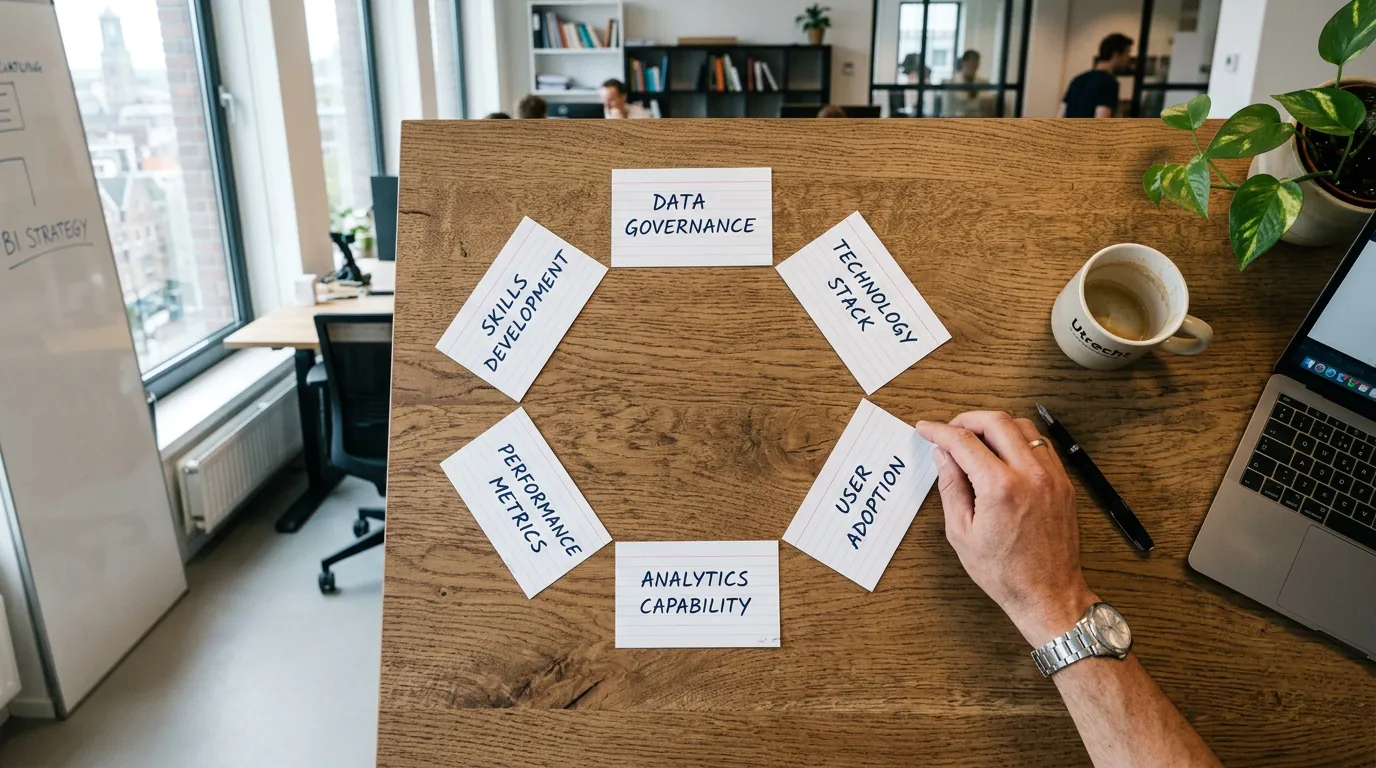
The “Data-to-Done Strategy Loop” is a 6-pillar framework that prevents the most common BI failure mode: building dashboards without decisions. Each pillar maps executive intent to governed data products, adoption, and measurable impact. For Benelux firms in the €10M–€50M range, all six pillars are required — but the sequencing and investment weight differ by maturity level.
Pillar 1 — Business Objectives Alignment
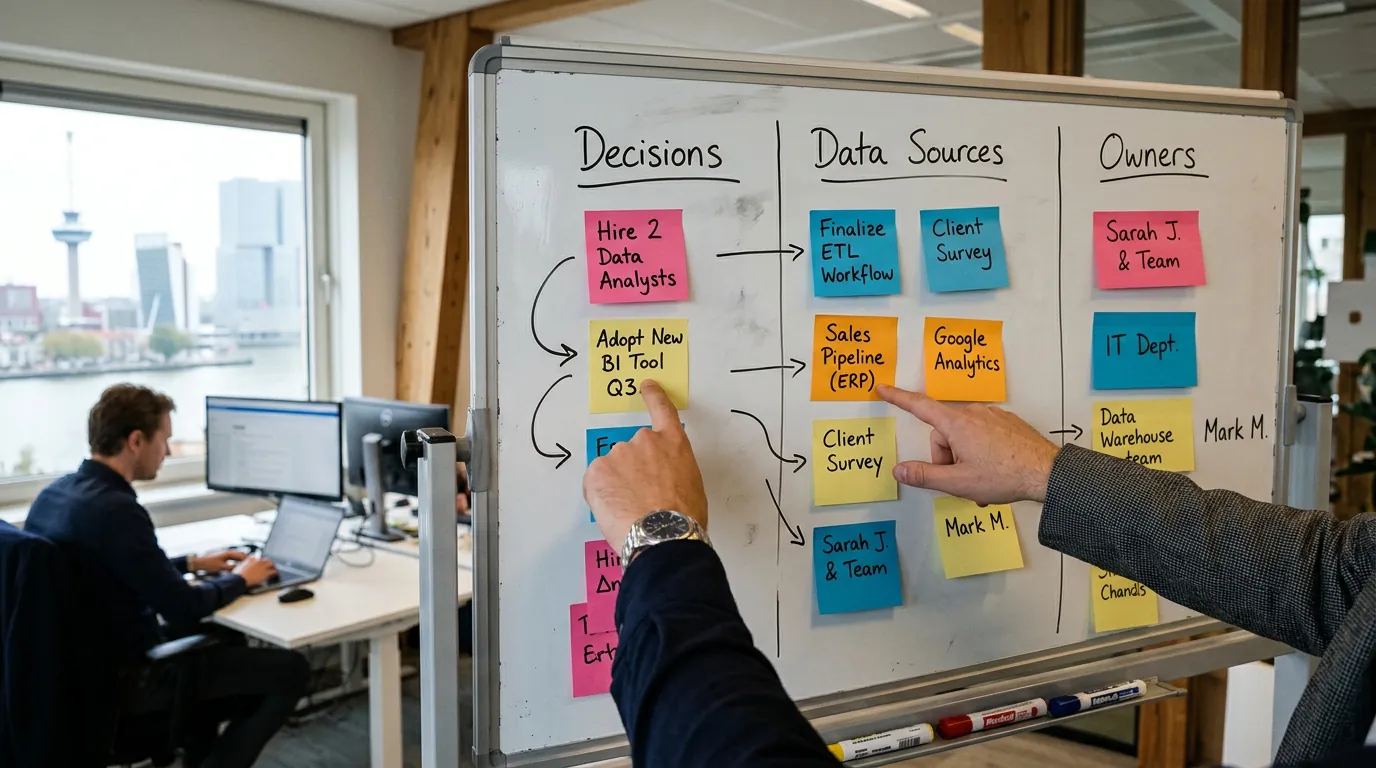
Start here or fail later. This pillar forces the organization to define the 5–10 decisions that actually move EBITDA, cash flow, or risk — and to assign a named human being responsible for each one.
A practical example: a logistics company with 180 employees in Eindhoven identified three decisions that drove 80% of their margin variance — route profitability by customer, driver utilization by week, and fuel cost per kilometer by vehicle class. Every BI investment was subsequently evaluated against whether it improved the quality or speed of those three decisions. Dashboards that did not connect to them were deprioritized, regardless of how technically impressive they were.
Deliverables for this pillar: a decision inventory (top 10), North Star outcomes with KPIs, and a decision-owner map (RACI-lite).
Pillar 2 — Data Architecture & Infrastructure
This is where strategy meets engineering — and where most organizations underinvest. The question is not “what database should we use?” but “what data products do we need to build, and what quality standards must they meet?”
A data product is a governed, reusable analytical asset with defined inputs, logic, quality thresholds, refresh cadence, and SLAs. A sales dashboard is not a data product. A certified “revenue by customer segment” metric with a documented calculation, a named owner, and a 99.5% freshness SLA is.
The CBS ICT usage data for 2024 shows that Dutch mid-market firms have high cloud adoption rates — 68% of enterprises with 50–250 employees now use cloud-based BI solutions, significantly above the EU average of 42%. Cloud infrastructure is not the bottleneck. Data product discipline is.
Pillar 3 — Technology Stack Selection
Vendor-neutral advice is rare in this space. Most BI content is produced by vendors with an obvious interest in steering you toward their platform. Here is a selection scorecard you can apply to any tool:
| Criteria | Weight | What to Evaluate |
|---|---|---|
| Connectivity to your data sources | 25% | Native connectors vs. custom ETL required |
| Self-service capability | 20% | Can business users build reports without IT? |
| Governance & security features | 20% | Row-level security, audit logs, GDPR compliance |
| Scalability | 15% | Performance at 10x current data volume |
| Total cost of ownership (3-year) | 15% | Licensing + implementation + training + maintenance |
| Vendor stability & roadmap | 5% | Market position, AI integration direction |
Score each shortlisted tool 1–5 per criterion, multiply by weight, sum the total. The highest score wins — not the most impressive demo.
Pillar 4 — People & Skills Development
Here is the honest part most frameworks skip: you can have perfect data architecture and the right tools, and still fail because no one in the organization can interpret the outputs critically.
Data literacy is not a training program. It is a sustained investment in building the organizational muscle to ask better questions of data. The pattern across our client engagements is clear: organizations that assign “data champions” within each business unit — not IT staff, but finance managers, operations leads, and commercial directors who own specific metrics — outperform those that centralize all analytical work in a data team.
Pillar 5 — Governance & Security
Eurostat data shows that 93% of EU enterprises applied at least one ICT security measure in 2024. Security compliance is table stakes. Governance is the harder problem.
The federated vs. centralized governance debate has a practical answer for Benelux mid-market firms: start centralized, federate deliberately. A central data governance function defines standards, metric definitions, and quality thresholds. Business units own their data products within those standards. Attempting full federation before standards exist produces the data anarchy described earlier.
GDPR compliance is non-negotiable and should be embedded in data product design, not bolted on afterward. Every data product spec should include a data classification field and a retention policy from day one.
Pillar 6 — Change Management & Adoption
The most underestimated pillar. A BI initiative that no one uses is not a technology failure — it is a change management failure.
The psychological barrier is specific: managers who have built their professional identity around gut-feel decision-making often experience data-driven alternatives as a threat to their credibility, not as a tool. Effective adoption strategies address this directly. Show managers how data confirms and sharpens their instincts rather than replacing them. Celebrate decisions where data and experience aligned. Build psychological safety around being wrong in the data before being wrong in the market.
Building Your BI Strategy: Step-by-Step
A BI strategy is built in six steps, from current-state assessment through KPI definition. The full cycle takes 8–12 weeks for a Benelux mid-market firm. Attempting to compress it into 2–3 weeks produces a strategy that looks complete on paper but collapses at execution. The 90-day quick win phase that follows is where momentum is built or lost.
Step 1 — Current State Assessment (BI Maturity)
Use the maturity model above. Add a data inventory: list every system that holds business-critical data (ERP, CRM, spreadsheets, operational databases), who owns it, and whether it has a documented schema. Most organizations discover 3–5 critical data sources they had forgotten about. Some discover that their “single source of truth” ERP contains 4 years of uncleaned historical data that will require significant remediation before it is analytically useful.
Step 2 — Stakeholder Mapping & Requirements
Interview decision-makers, not data consumers. The question is not “what reports do you need?” — that produces a wish list of dashboards. The question is “what decisions do you make weekly that you wish you made faster or with more confidence?” That question produces a decision inventory.
A distribution company with 220 employees in Ghent ran this exercise and identified that their commercial director made pricing decisions based on a manually updated Excel file that was 3–5 days stale. The cost of that staleness, estimated conservatively, was 2–3% margin leakage per quarter on their largest accounts.
Step 3 — Gap Analysis & Prioritization
Map the decision inventory against current data availability and quality. Score each potential BI use case on three dimensions: business value (impact on EBITDA/risk), data feasibility (is the data available and clean enough?), and time-to-first-proof (how quickly can a prototype be validated?).
High-value, high-feasibility, fast-proof use cases go into the 90-day wave. High-value, low-feasibility use cases go into the data foundation backlog — you need to fix the data before you can build the analytics.
Step 4 — Technology Selection & Architecture Design
Apply the scorecard from Pillar 3. For most Benelux SMEs at Level 2–3 maturity, the right answer is a cloud-based BI platform (Power BI, Looker, or Tableau depending on your existing Microsoft/Google/Salesforce ecosystem) connected to a lightweight data warehouse. The temptation to build a full modern data stack — data lake, transformation layer, semantic layer, BI tool — before you have validated use cases is a common and expensive mistake.
Start with the minimum architecture that supports your 90-day use cases. Expand the architecture as use cases demand it.
Step 5 — Roadmap Development
| Phase | Timeline | Focus | Example Deliverables |
|---|---|---|---|
| Phase 1: Quick Wins | 0–90 days | 2–3 high-value, high-feasibility use cases | Sales pipeline dashboard, operational KPI scorecard, first certified metric |
| Phase 2: Foundation | 3–6 months | Data infrastructure, governance framework, data quality remediation | Data warehouse, metric dictionary, governance policy |
| Phase 3: Scale | 6–12 months | Self-service rollout, additional use cases, data literacy program | Self-service BI for 3+ business units, predictive model pilots |
The 90-day phase is not about building everything. It is about proving that the approach works, building organizational confidence, and creating visible wins that secure continued investment.
Step 6 — KPI Definition & Success Metrics
Define success at two levels. Business KPIs measure whether the decisions improved (e.g., pricing accuracy, forecast error rate, customer churn rate). BI program KPIs measure whether the platform is being used effectively (e.g., weekly active users, report adoption rate, data quality score).
Both matter. A BI program with high adoption but no improvement in business KPIs means people are looking at data without changing behavior. A program with improved business KPIs but low adoption means a few power users are carrying the organization — a fragile situation.
If you want an expert perspective on where your organization sits before committing to a roadmap, our Data Foundation diagnostic is a structured starting point — not a sales pitch.

BI Strategy by Company Size
The six pillars apply universally, but the implementation weight, budget, and tooling assumptions differ significantly by company size. A 60-person professional services firm in Amsterdam needs a fundamentally different approach than a 400-person manufacturer in Antwerp — same destination, different vehicles.
| Dimension | SME (50–200 employees) | Mid-Market (200–1,000) | Enterprise (1,000+) |
|---|---|---|---|
| Typical BI budget | €30K–€80K/year | €100K–€400K/year | €500K–€5M+/year |
| Team structure | 1 analyst + BI tool | 2–5 person data team | Dedicated BI/data org |
| Governance model | Centralized, lightweight | Centralized with BU champions | Federated with central standards |
| Recommended stack | Cloud BI + existing ERP connectors | Cloud data warehouse + BI platform | Full modern data stack |
| 90-day priority | 2–3 certified metrics, 1 dashboard | Use-case portfolio, data foundation | Governance framework, center of excellence |
| Biggest risk | Tool sprawl, no governance | Scope creep, data quality debt | Organizational silos, shadow IT |
| AI readiness timeline | 18–24 months from Level 2 | 12–18 months from Level 3 | 6–12 months from Level 4 |
SME (50–200 Employees): Lean BI Strategy
The lean BI approach prioritizes ruthless prioritization over comprehensiveness. Pick three decisions. Build the data products that support those three decisions. Prove value. Expand. A 75-person e-commerce retailer in Utrecht does not need a data lake. They need clean order, margin, and customer retention data in a tool their commercial director can use on Monday morning without calling IT.
The Netherlands ranks 6th in the EU for AI adoption at 22.7% versus the EU average of 13.5% — but that headline masks a significant gap between the information and communication sector (58% adoption) and the broader SME population. Most SMEs are still in the early stages of even basic BI, let alone AI.
Mid-Market (200–1,000 Employees): Scalable BI Strategy
The mid-market challenge is different: you have enough complexity to need real architecture, but not enough resources to build it the enterprise way. The right move is a scalable-but-not-overbuilt data warehouse (cloud-native, managed service) with a BI platform that supports both governed reporting and self-service exploration.
Governance becomes critical at this size. Without a metric dictionary and data ownership model, you will hit the “conflicting KPIs” problem within 12 months of deployment.
Enterprise (1,000+ Employees): Enterprise BI Strategy
At enterprise scale, the technical problems are largely solved. The organizational problems are not. Shadow BI — business units building their own analytics outside the central platform — is the dominant failure mode. A center of excellence model, where a central team sets standards and supports business units rather than owning all delivery, is the most effective governance structure for organizations above 1,000 employees.
The Five Most Expensive BI Mistakes
The five most costly BI strategy mistakes share a common root: they all stem from treating BI as a technology project rather than a business change program. Each mistake has a specific organizational signature and a specific intervention. Recognizing them early saves 6–18 months of wasted effort.

Mistake 1 — Starting with Tools Instead of Questions
The signature: IT selects a BI platform, procurement signs the license, and then someone asks “what do we want to build?” The organization spends 6 months building dashboards that no one requested for decisions no one has defined.
The fix: run the decision inventory exercise before any tool evaluation. The tool selection follows the use case requirements — not the other way around.
Mistake 2 — Ignoring Data Quality
Data quality problems are not discovered during BI implementation. They are exposed by it. The moment you try to join your CRM and ERP data to calculate customer profitability, you discover that 23% of customer records have mismatched IDs, 8% have missing industry codes, and the revenue figures use three different recognition methodologies.
Plan for data remediation as a first-class workstream. Budget 20–30% of your initial BI investment for it.
Mistake 3 — No Executive Sponsorship
A BI initiative without a named C-level sponsor is a project waiting to be deprioritized. The sponsor does not need to understand the technology. They need to visibly use the outputs, advocate for the investment in budget discussions, and resolve organizational conflicts when data governance requires business units to change how they work.
Mistake 4 — Over-Scoping the First Phase
The ambition to “build a single source of truth for the entire organization” in Phase 1 is the most reliable predictor of BI project failure. Scope the first phase to two or three use cases maximum. Deliver them well. Let the organizational credibility of those wins fund the expansion.
Mistake 5 — Neglecting User Adoption
This is where most BI investments quietly die. The platform is live. The dashboards are built. Usage peaks in week two and then declines steadily. By month six, only three people are logging in regularly.
The intervention is behavioral, not technical. Embed BI outputs into existing meeting rhythms — the Monday commercial review, the weekly operations standup, the monthly board pack. When data becomes part of how decisions are already made, adoption becomes structural rather than dependent on individual motivation.
The pattern across our client engagements is consistent: organizations that treat adoption as a Phase 3 problem — something to address after the platform is live — spend 40–60% more on change management remediation than those who design for adoption from day one. Our Operational Intelligence work always starts with the adoption model, not the dashboard spec.
Key Takeaways
- Strategy before tools, always. A business intelligence strategy defines the decisions that need data before any platform is selected. Organizations that invert this sequence consistently overspend and underdeliver. Gartner research indicates only 20% of analytical insights deliver business outcomes when strategy and objectives are misaligned.
- Know your maturity level before setting your ambition. The 5-level BI Maturity Model provides a realistic starting point. Most Benelux SMEs operate at Level 2–3. Attempting to jump to Level 5 without the governance infrastructure of Level 3–4 produces expensive failures. IDC projects a 15% productivity loss for organizations that deploy AI without AI-ready data foundations by 2027.
- The 90-day quick win phase determines long-term success. Organizational confidence in BI is built through early, visible wins — not comprehensive platforms. Scope Phase 1 to 2–3 high-value, high-feasibility use cases and deliver them well.
- Data quality is a strategy problem, not a technical afterthought. Budget 20–30% of initial BI investment for data remediation. BI implementation exposes data quality issues — it does not create them.
- Adoption is a design decision, not a deployment task. Embedding BI outputs into existing decision-making rhythms from day one reduces change management costs by 40–60% compared to post-launch adoption programs.
Frequently Asked Questions
What is a business intelligence strategy in simple terms?
A business intelligence strategy is the organizational plan that connects your data capabilities to the decisions that drive business outcomes. It defines which decisions need data, what infrastructure supports them, who owns the outputs, and how success is measured. It is the difference between having dashboards and having decisions.
How long does it take to build a BI strategy?
For a Benelux mid-market company with 100–500 employees, a complete BI strategy — from current-state assessment through roadmap development — takes 8–12 weeks. Compressing this to 2–3 weeks produces a strategy that looks complete but lacks the stakeholder alignment and data inventory detail needed for execution.
What is the difference between a BI strategy and a data strategy?
A data strategy covers how an organization manages, governs, and uses all its data assets — including operational, regulatory, and analytical uses. A BI strategy is a subset focused specifically on analytical decision-making: which decisions need data, what reports and models support them, and how insights reach decision-makers. You need both, but for most SMEs, the BI strategy is the practical starting point.
How much does a BI strategy implementation cost for a Dutch SME?
A lean BI implementation for a 50–200 employee Dutch company typically runs €30,000–€80,000 annually, including tooling, implementation, and initial training. The data foundation work — data warehouse setup, data quality remediation — often adds €20,000–€40,000 in year one. These figures vary significantly by data complexity and existing infrastructure.
What BI tools are best for Benelux mid-market companies?
The right tool depends on your existing technology ecosystem, not vendor marketing. Microsoft-heavy organizations typically get the best ROI from Power BI. Google Workspace organizations often find Looker more natural. Salesforce-centric commercial teams frequently benefit from Tableau. Apply the vendor-neutral scorecard in this article — connectivity, self-service, governance, scalability, TCO, and vendor stability — to any shortlist before deciding.
How do you measure the ROI of a business intelligence strategy?
Measure ROI at two levels: business KPIs (did the decisions improve? — pricing accuracy, forecast error, customer retention) and program KPIs (is the platform being used? — weekly active users, report adoption rate, data quality score). Business KPI improvement is the ultimate measure. Program KPIs are leading indicators. A BI program with high adoption but flat business KPIs means data is visible but not actionable.
What is the biggest reason BI strategies fail?
The single most common failure mode is misalignment between data investments and business decisions — building dashboards for decisions no one defined. Gartner estimates this accounts for 80% of digital scaling failures. The remedy is a decision inventory conducted before any tool selection or dashboard development begins.
Related Articles
- The AI Paradox: Why Most AI Investments Fail — and What the 5% Do Differently — Understand why the same organizational patterns that derail BI strategies also derail AI investments.
- The Data-to-Done Framework: 7 Phases of Custom AI Development — When your BI strategy matures to the point of AI integration, this framework maps the development path.
- Five Signs You Have Outgrown Off-the-Shelf AI — The BI maturity journey often ends with this realization: generic tools have a ceiling.
- The 7 Most Expensive Mistakes in Custom AI Projects — The mistake patterns in BI strategy and AI projects overlap more than most organizations expect.
Ready to move from data chaos to decision clarity? Veralytiq has guided Benelux organizations across manufacturing, logistics, professional services, and retail through BI strategy development — from maturity assessment through 90-day delivery. Our approach is vendor-neutral, outcome-first, and built on the principle that strategy precedes tooling, always. That is what “From Data to Done” means in practice.
Plan a free introductory meeting — 45 minutes, no sales deck, just an honest conversation about where your organization sits and what a realistic path forward looks like.
Sources
- IDC Worldwide Enterprise Intelligence Services Forecast, 2025 — IDC, 2025
- IDC Worldwide Artificial Intelligence IT Spending Forecast, 2025–2029 — IDC, August 2025
- From Risk to Reward: The Dual Reality of Agentic AI in the Enterprise — IDC, 2026
- Agent Adoption: The IT Industry’s Next Great Inflection Point — IDC, 2026
- FutureScape 2026: Moving into the Agentic Future — IDC, 2026
- Use of AI Technology by Dutch Companies — AI Monitor 2024 — CBS (Centraal Bureau voor de Statistiek), 2025
- Increasing Use of AI by Business — CBS, September 2025
- 93% of EU Businesses Apply ICT Security Measures — Eurostat, December 2024
- ICT Use in Companies; Industry and Company Size, 2024 — Eurostat / CBS, 2024
- ICT Usage in Enterprises — Eurostat Metadata (Netherlands) — European Commission / Eurostat, 2024
- Netherlands Leads EU in Sustainable ICT Practices for Businesses — IndexBox, 2024
- Where Is AI on Gartner’s 2025 Hype Cycle and Why ROI Is the Real Test — ActiveLogic (referencing Gartner), 2025
- Gartner Magic Quadrant for Business Intelligence 2025 — Reveal and Analysis — Gartner / YouTube, 2025
- Agentic AI Market Size, Trends & Forecast, 2025–2032 — Coherent Market Insights, 2025 (vendor market research; figures are directional estimates)