



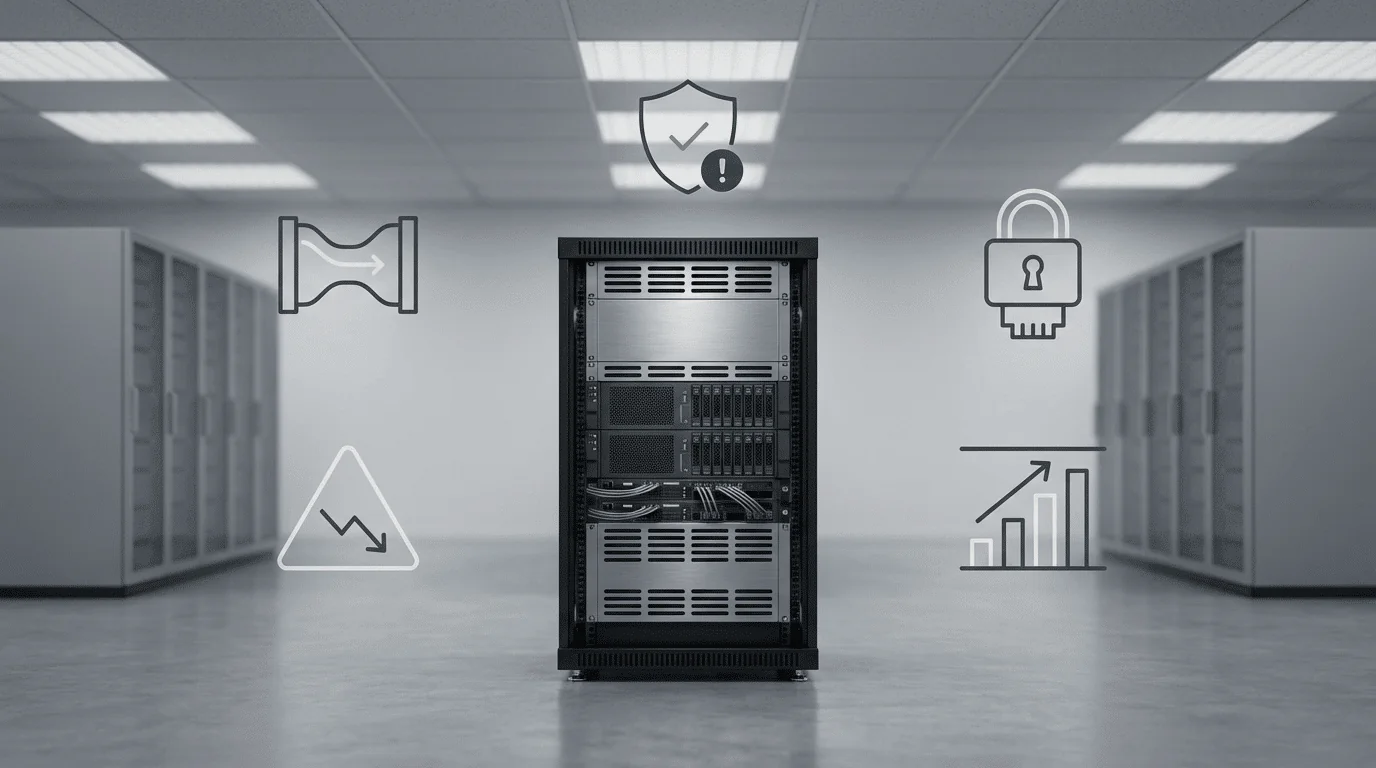
Five indicators signal that generic AI tools are holding your business back: your data lives in systems the tool cannot reach, your competitive insights are leaking to shared platforms, domain accuracy has plateaued below 80%, scaling costs now exceed custom-build costs, and your compliance obligations outstrip the vendor’s capabilities. When three or more of these signs are present simultaneously, the business case for custom AI shifts from “nice to have” to “strategic imperative.”
Off-the-shelf AI tools are not failures. They serve a vital purpose: rapid deployment, low upfront cost, and fast validation of whether AI adds value to a process. According to Andreessen Horowitz’s 2025 enterprise AI survey of 100 CIOs, off-the-shelf solutions are “eclipsing custom builds” for initial adoption. But adoption and impact are different things. McKinsey’s 2025 research reveals that nearly eight in ten companies have deployed generative AI, yet roughly the same proportion report no material impact on earnings. The tool is working. The results are not.
This article identifies the five most reliable indicators that an organisation has reached the ceiling of what off-the-shelf AI can deliver — and explains what each sign means for the decision to invest in custom AI. These are not theoretical signals. They are operational patterns that appear consistently across industries and company sizes.
Sign 1: Your Data Lives in Systems the Tool Cannot Reach
When your most valuable data sits in legacy ERP systems, proprietary databases, or industry-specific platforms that your off-the-shelf AI tool cannot connect to, you are running AI on a fraction of your information — and getting a fraction of the possible value.
Informatica’s CDO Insights 2025 survey identifies data quality and readiness as the top obstacle for 43% of organisations pursuing AI. But there is a more fundamental problem than data quality: data accessibility. Off-the-shelf tools typically connect to mainstream platforms — Salesforce, Microsoft 365, Google Workspace, Shopify — through standard APIs. If your critical data lives in a legacy Transport Management System, a Dutch-built ERP, a proprietary quality control database, or a combination of Excel files maintained by domain experts, the AI tool simply cannot see it.
The consequence is not that AI fails spectacularly. It is that AI performs adequately — just well enough to seem useful, but never well enough to transform operations. A demand forecasting tool connected only to your CRM will produce forecasts based on order history alone. But the factors that actually drive demand in your business — port congestion at Rotterdam, seasonal workforce availability, supplier lead time variability, weather-dependent logistics costs — live in systems the tool cannot access.
The diagnostic question: Does your AI tool have access to more than 60% of the data that a domain expert would use to make the same decision? If the answer is no, you have outgrown the tool’s data integration capability.
Custom AI solutions solve this by building the data pipeline as part of the project. The integration architecture is designed around your specific systems — not limited to the vendor’s pre-built connectors. Successful AI programmes invest 50–70% of their timeline in data readiness, including extraction from legacy systems, normalisation across data formats, and governance metadata — work that no off-the-shelf tool is designed to perform.
Sign 2: Your Competitive Insights Are Leaking to Shared Platforms
When your proprietary data feeds into a vendor’s shared model that also serves your competitors, every insight you generate simultaneously improves the platform available to everyone in your industry — eroding competitive advantage with every query.
This is the least visible but most strategically dangerous limitation of off-the-shelf AI. Most SaaS AI tools operate on shared infrastructure. Your queries, your data patterns, and your usage behaviour may contribute to model improvements that benefit all users of the platform — including your direct competitors.
Consider a scenario: your company and your three largest competitors all use the same AI-powered pricing optimisation tool. Each company feeds transaction data into the platform. The vendor’s model improves based on aggregate patterns. The result is that all four companies converge toward similar pricing strategies, eliminating any competitive differentiation from AI. According to BCG’s 2024 research, organisations employing advanced, tailored AI technologies achieve revenue growth 1.5 times higher and shareholder returns 1.6 times higher over three years. Shared tools cannot deliver this kind of differentiation.
The diagnostic question: Do your competitors have access to the same AI tool, processing similar data, for the same use case? If yes, the tool is a commodity — not a competitive advantage.
Custom AI addresses this directly through IP ownership. A model trained on your proprietary data encodes institutional knowledge that competitors cannot replicate. Deloitte’s 2026 State of AI report finds that 85% of companies expect to customise AI agents for their unique business needs — a clear market signal that organisations recognise shared tools alone are insufficient for strategic advantage.
Sign 3: Domain Accuracy Has Plateaued Below Acceptable Thresholds
When your off-the-shelf AI tool consistently delivers accuracy below 80% for domain-specific tasks — and no amount of prompt engineering, configuration, or fine-tuning within the tool’s parameters can improve it — you have hit the ceiling of what a generic model can achieve for your specific use case.
Generic AI models are trained on broad datasets to perform well across many tasks. This breadth comes at the cost of depth. A general-purpose language model understands that “container” means a box in everyday English and a Docker container in software engineering. But it may not understand that in your specific logistics operation, “container” refers to a 40ft high-cube reefer container with specific temperature requirements that affect routing decisions.
MIT’s NANDA study identifies a revealing pattern: employees use personal AI tools like ChatGPT enthusiastically for simple tasks but abandon them for mission-critical work. The reason is accuracy. As one corporate lawyer in the MIT study explained, her company invested $50,000 in a specialised contract analysis tool, yet she consistently defaulted to ChatGPT for simple tasks and manual review for complex ones — because neither AI tool achieved sufficient accuracy for high-stakes legal work.
Research indicates that organisations investing in rigorous, domain-specific data preparation achieve 40–60% better performance outcomes compared to those deploying generic models on the same tasks. The accuracy gap is not a software bug — it is a structural limitation of models trained for breadth rather than depth.
The diagnostic question: Track your AI tool’s accuracy on 100 consecutive domain-specific decisions. If accuracy is below 80% and has not improved in the last 90 days despite configuration changes, the tool has reached its generic ceiling.
Sign 4: Scaling Costs Now Exceed Custom-Build Costs
When your off-the-shelf AI subscription costs have escalated to a point where the annual spend approaches or exceeds the one-time cost of building a custom solution — typically at the 18–24 month mark — the financial argument shifts decisively in favour of custom AI as an owned asset rather than a rented service.
Off-the-shelf pricing models are designed to be attractive at entry and expensive at scale. Per-user, per-query, and per-document pricing works well when usage is low. But as AI adoption grows within an organisation — more users, more queries, more data processed — costs compound in ways that are difficult to predict at the outset.
A practical example: a mid-sized company starts with an AI-powered document processing tool at €2,500/month for 50 users. Over 12 months, success drives adoption. The tool expands to 200 users across three departments, with increased document volumes. The monthly cost escalates to €12,000. At €144,000/year and rising, the company is spending more annually on the subscription than it would cost to build a custom solution (€80,000–€150,000 one-time) that it would own outright.
According to industry TCO analysis, annual maintenance for custom AI typically runs 15–25% of the initial development cost. A €100,000 custom solution costs €15,000–€25,000/year to maintain — compared to €144,000+/year for the scaled-up subscription. Over three years, the custom solution costs €145,000–€175,000 total. The subscription costs €432,000+ and continues to grow.
The diagnostic question: Calculate your current AI subscription cost (including add-ons, overage charges, and integration workarounds) on an annual basis. If this number exceeds €75,000/year and is growing, request a custom AI cost estimate for comparison. The crossover point may already be behind you.
Dutch subsidies accelerate this crossover further. The WBSO programme covers a significant portion of custom AI R&D costs, effectively reducing the one-time investment by 30–40%. A €100,000 custom build with WBSO support has an effective cost of €60,000–€70,000 — making the subscription-to-custom crossover point even earlier.
Sign 5: Compliance Requirements Outstrip the Vendor’s Capabilities
When your regulatory obligations — EU AI Act classification, GDPR data residency, industry-specific audit requirements, or sector-specific governance standards — demand transparency, auditability, and control that your off-the-shelf vendor cannot provide, the compliance gap becomes a business risk that no configuration can close.
The EU AI Act, with full enforcement rolling out through 2026, classifies AI systems by risk level. High-risk categories — including credit scoring, employee evaluation, recruitment, and certain healthcare applications — require: transparency about how the AI makes decisions, documentation of training data and model architecture, human oversight mechanisms, regular bias testing and monitoring, and data governance compliance.
Off-the-shelf vendors may provide general compliance certifications (SOC 2, ISO 27001), but they rarely offer the granular transparency required for high-risk AI classifications. You cannot audit a model you do not own. You cannot document training data you cannot access. You cannot demonstrate human oversight over decisions made by a black-box algorithm.
Deloitte’s 2026 report reveals that while 42% of companies consider their strategy prepared for AI adoption, preparedness drops significantly for risk and governance. Only 21% of companies report having a mature governance model for autonomous AI agents. For organisations in regulated industries operating in the EU, this governance gap is not merely an operational concern — it is a potential regulatory violation.
The diagnostic question: Can you answer these four questions about your current AI tool? (1) What data was it trained on? (2) How does it make specific decisions? (3) Can you audit its outputs for bias? (4) Do you control where your data is processed and stored? If any answer is no, and your AI application falls within an EU AI Act high-risk category, you have a compliance gap that only custom AI — with full transparency and auditability — can close.
Gartner predicts that over 40% of agentic AI projects will be cancelled by the end of 2027 due to escalating costs, unclear business value, or inadequate risk controls. Compliance-by-design in custom AI avoids this outcome by building governance into the system architecture from day one.
The Outgrowth Scoring Matrix: Assess Your Situation
Rate each of the five signs on a 0–3 scale (0 = not applicable, 1 = minor issue, 2 = significant constraint, 3 = critical blocker). A total score of 8 or above indicates a strong business case for custom AI investment.
| Sign | Your Score (0–3) | Weight |
| 1. Data lives in unreachable systems | ___ | Critical |
| 2. Competitive insights leaking | ___ | High |
| 3. Domain accuracy below 80% | ___ | High |
| 4. Scaling costs exceed custom-build | ___ | Medium |
| 5. Compliance gap | ___ | Critical (regulated) |
| TOTAL | ___ / 15 |
Score interpretation: 0–4: Off-the-shelf remains appropriate. Optimise configuration before considering custom. 5–7: Hybrid approach recommended. Keep off-the-shelf for commodity tasks, scope a custom pilot for the highest-scoring sign. 8–11: Strong case for custom AI. Begin vendor evaluation and project scoping. 12–15: Urgent. Continued reliance on off-the-shelf tools represents material business risk.
What to Do When You Recognise the Signs
Recognising the signs is the diagnostic step. The prescriptive step is a structured 90-day evaluation: validate the business case, scope the highest-impact use case, select an implementation partner, and run a time-boxed pilot with measurable success criteria.
The worst response to these signs is a large, multi-year “AI transformation” programme. MIT’s NANDA study shows that the most successful AI projects “pick one pain point, execute well, and partner smartly.” Mid-market firms that follow this approach scale AI pilots in approximately 90 days — compared to nine months for large enterprises.
The practical sequence is: (1) Select the sign with the highest score and greatest financial impact. (2) Define a specific, measurable outcome for that use case. (3) Evaluate 2–3 implementation partners with domain expertise in your industry. (4) Commission a 90-day pilot with a predefined success metric. (5) Measure, validate, and decide: scale, pivot, or stop.
This is the approach Veralytiq applies through its From Data to Done methodology — starting with the business problem, not the technology; investing in data readiness before model development; and validating results within a defined timeframe before committing to full-scale deployment.
The financial risk of this approach is remarkably low. A 90-day pilot for a well-scoped use case typically costs €25,000–€60,000. With WBSO subsidy coverage of 30–40%, the effective out-of-pocket cost drops to €15,000–€42,000 — less than many organisations spend on a single quarter of their existing off-the-shelf subscriptions. The pilot produces one of three outcomes: validated ROI that justifies full deployment, a clear pivot direction based on real data, or a definitive signal that the use case does not warrant further investment. All three outcomes deliver value because they replace uncertainty with evidence.
Critically, the transition does not require dismantling your existing AI tools. Gartner forecasts that 40% of enterprise applications will feature task-specific AI agents by the end of 2026 — a model where custom AI agents handle high-value tasks while off-the-shelf tools manage commodity functions. This coexistence is not a compromise; it is the target architecture.
Veelgestelde Vragen
How do I know if my company needs custom AI?
Use the five-sign diagnostic in this article. If you score 8 or above on the outgrowth matrix, the limitations of off-the-shelf tools are materially constraining your business outcomes. The highest-scoring sign indicates where to begin your custom AI evaluation.
Can I fix off-the-shelf limitations with better configuration?
Configuration can address surface-level issues: better prompts, adjusted parameters, additional modules. But it cannot fix structural limitations: data the tool cannot access, accuracy ceilings inherent to generic models, compliance gaps in black-box systems, or competitive advantage from shared platforms. If the limitation is structural, only custom AI resolves it.
What if I only score high on one sign?
A single high-scoring sign can still justify custom AI if the financial impact is significant. A logistics company scoring 3 on “data in unreachable systems” but 0–1 on everything else may still benefit from a custom data pipeline that unlocks forecasting accuracy improvements worth hundreds of thousands per year.
How quickly can I transition from off-the-shelf to custom?
MIT’s data shows mid-market firms scale custom AI pilots in 90 days. A phased transition — running off-the-shelf and custom solutions in parallel during the pilot — minimises risk. Once the custom solution is validated, the off-the-shelf subscription can be reduced or terminated.
Are Dutch subsidies available for the transition?
Yes. The WBSO programme covers AI R&D development costs. Combined with the MIT R&D subsidy and the Innovatiebox tax benefit, effective custom AI project costs can be reduced by 30–45%, significantly accelerating the payback period.
Does outgrowing off-the-shelf mean abandoning it entirely?
No. The hybrid approach is the optimal strategy for most mid-market companies: keep off-the-shelf tools for commodity tasks (email productivity, meeting transcription, basic reporting) and invest in custom solutions for strategic processes where data integration, accuracy, and competitive differentiation drive measurable business value.
Key Takeaways
- Five signs indicate you have outgrown off-the-shelf AI: unreachable data, leaking competitive insights, accuracy plateaus below 80%, scaling costs exceeding custom-build costs, and compliance gaps.
- A scoring matrix (0–15) enables objective self-assessment: 8+ indicates a strong business case for custom AI.
- The transition from off-the-shelf to custom is not all-or-nothing — the hybrid approach (commodity off-the-shelf + strategic custom) is optimal for most mid-market companies.
- Mid-market firms scale custom AI pilots in 90 days — the outgrowth diagnosis does not require a multi-year transformation programme.
- Dutch subsidies (WBSO, MIT, Innovatiebox) reduce effective custom AI costs by 30–45%, accelerating the financial crossover from subscription to ownership.
Sources
1. MIT Project NANDA — The GenAI Divide: State of AI in Business 2025, July 2025. fortune.com
2. McKinsey & Company — Seizing the Agentic AI Advantage, June 2025. mckinsey.com
3. BCG — AI Adoption in 2024: 74% of Companies Struggle to Achieve and Scale Value, October 2024. bcg.com
4. Deloitte AI Institute — State of AI in the Enterprise 2026, January 2026. deloitte.com
5. Deloitte Press Release — From Ambition to Activation, January 2026. deloitte.com
6. Andreessen Horowitz — How 100 Enterprise CIOs Are Building and Buying Gen AI in 2025, June 2025. a16z.com
7. WorkOS — Why Most Enterprise AI Projects Fail, July 2025. Cites McKinsey & Informatica CDO Insights 2025. workos.com
8. Naitive.cloud — Custom AI Models vs Off-the-Shelf: ROI Breakdown, July 2025. blog.naitive.cloud
9. Gartner — Predicts Over 40% of Agentic AI Projects Will Be Canceled by End of 2027. gartner.com
10. European Commission — Regulatory Framework for AI (EU AI Act). digital-strategy.ec.europa.eu
11. RVO — WBSO Subsidie. rvo.nl
12. Kore.ai — State of Enterprise AI in 2025: A Decision-Maker’s Guide, November 2025. kore.ai