



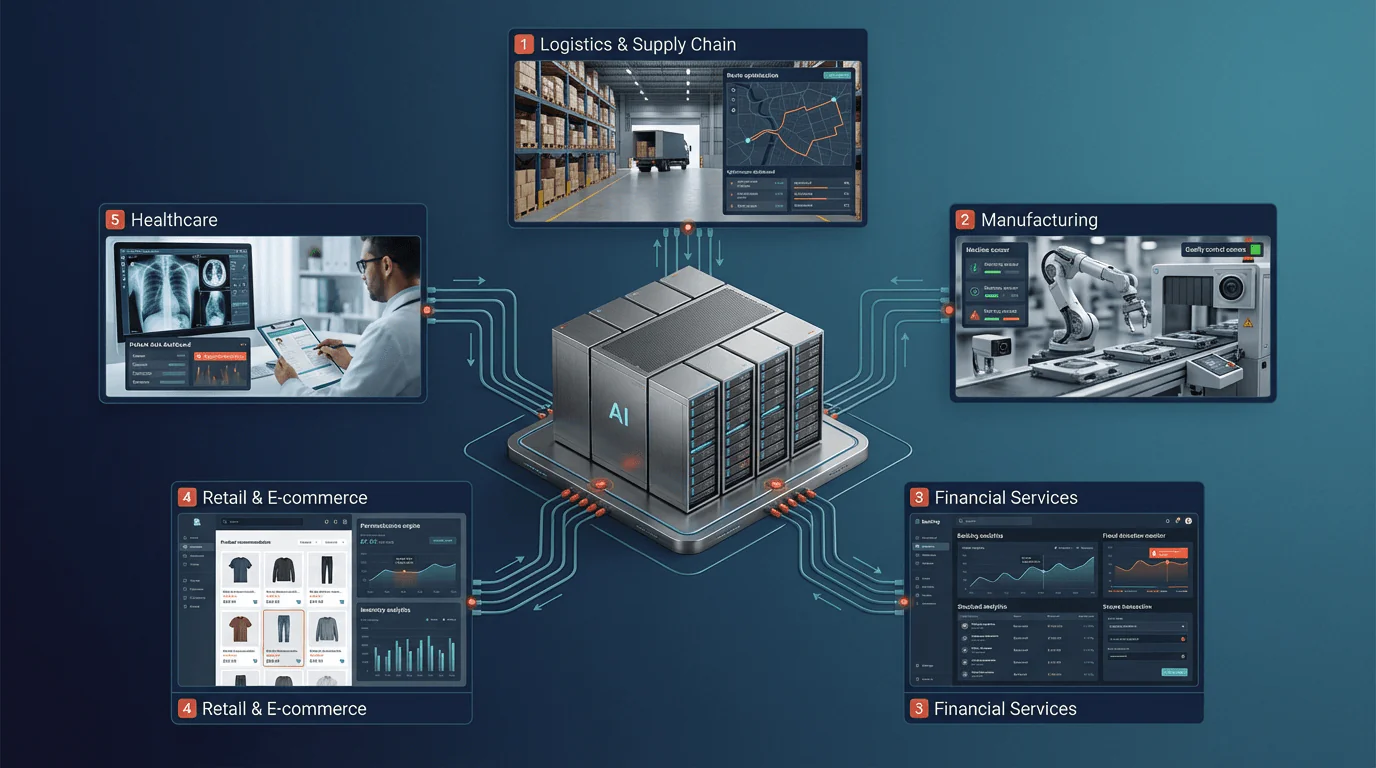
Custom AI delivers the highest ROI in five sectors where domain-specific data, complex decision-making, and operational precision determine competitive advantage: logistics and supply chain (15–25% cost reduction), manufacturing (25–40% lower maintenance costs), financial services (fraud detection accuracy above 95%), retail and e-commerce (5–15% revenue lift through personalisation), and healthcare (diagnostic support that reduces error rates by 20–30%). This article maps the top use cases per sector, quantifies their impact with sourced data, and provides Benelux-specific context for mid-market companies evaluating where custom AI will deliver the fastest, most measurable return.
Why Sector Context Determines AI Success
A custom AI solution for demand forecasting in logistics looks fundamentally different from a custom AI solution for fraud detection in insurance — not because the technology differs, but because the data, the decision logic, the compliance requirements, and the operational workflows are entirely sector-specific.
This is why generic AI tools plateau. 74% of companies struggle to extract value from AI because they deploy general-purpose tools for sector-specific problems. A chatbot trained on generic customer service data cannot understand that a “late delivery” in pharmaceutical logistics has entirely different urgency and regulatory implications than a “late delivery” in fashion e-commerce.
Custom AI succeeds where it encodes sector-specific domain knowledge into the model itself — the terminology, the decision thresholds, the regulatory constraints, and the operational patterns that define each industry. IDC research confirms an average ROI of $3.70 for every dollar invested in AI, but this average obscures enormous variation by sector and implementation quality. The sectors below represent the highest-ROI opportunities for custom AI in the Benelux mid-market.
1. Logistics & Supply Chain
Custom AI in logistics delivers 15–25% cost reduction through demand forecasting, route optimisation, and predictive maintenance — with the Port of Rotterdam, Europe’s largest logistics hub, creating a natural data advantage for Benelux companies.
Top Use Cases
Demand forecasting and inventory optimisation. AI models trained on historical shipment data, seasonal patterns, port congestion, weather, and customer order history predict demand with 85–95% accuracy. AI-enabled supply chains experience a 35% inventory reduction and 65% increase in service levels. For mid-market logistics firms, this translates to reduced warehouse costs, fewer stockouts, and better capital allocation.
Route optimisation and fleet management. McKinsey’s 2025 supply chain report indicates that AI-driven route optimisation reduces transport costs by 15–20%. A European logistics provider used AI route planning to cut average trip times by 18%, saving $12 million in fuel and driver hours in one year. In the dense Benelux road network, where distances are shorter but congestion is higher, route optimisation delivers disproportionate value.
Predictive maintenance for fleet and warehouse equipment. AI-powered predictive maintenance reduces unplanned downtime by up to 50% and lowers maintenance costs by 10–40%. For logistics companies operating vehicle fleets and automated warehouse systems, the difference between reactive and predictive maintenance can represent hundreds of thousands of euros annually.
Benelux Context
The Netherlands handles approximately 30% of all goods entering the European Union through the Port of Rotterdam and Schiphol Airport. This positioning creates a unique data ecosystem: Benelux logistics companies have access to richer, more diverse shipment data than most European counterparts. Custom AI models trained on this data — combining port congestion patterns, cross-border customs processing times, and multimodal transport data — create competitive advantages that generic tools cannot replicate. WBSO subsidies further reduce the effective investment, making custom AI accessible for mid-market logistics firms with 50–500 employees.
2. Manufacturing
Custom AI in manufacturing delivers 250–300% ROI through predictive maintenance, quality control, and production optimisation — with payback periods as short as 6–18 months for implementations on critical equipment.
Top Use Cases
Predictive maintenance. This is the single highest-ROI application of custom AI in manufacturing. AI-driven predictive maintenance can lower maintenance costs by 25–40% and reduce unplanned downtime by 50%. A major automotive manufacturer implemented AI-driven predictive maintenance across production lines, achieving a 35% reduction in unplanned downtime and $2.3 million in annual savings. The system monitors vibration, temperature, pressure, and acoustic patterns from sensors retrofitted to existing equipment — meaning implementation does not require replacing machinery.
Quality control and defect detection. Computer vision systems trained on your specific products and quality standards outperform manual inspection in speed, consistency, and accuracy. AI-powered quality control delivers 200–300% ROI through defect reduction and faster inspection cycles. Custom models are essential here because every manufacturer’s products, defect types, and quality thresholds are unique — a generic vision system trained on automotive parts will not detect defects in pharmaceutical packaging.
Production scheduling and energy optimisation. AI models that analyse production line performance, order queues, energy pricing, and equipment availability can optimise scheduling to reduce energy consumption by 12% and increase throughput by 10–15%. 78% of production facilities utilising AI report measurable waste reduction. For energy-intensive manufacturing in the Netherlands and Belgium, where energy costs remain elevated, this application delivers immediate financial impact.
Benelux Context
The Benelux manufacturing sector is characterised by high-precision, high-mix, low-volume production — automotive components, semiconductor equipment, food processing, and chemical production. These environments are ideal for custom AI because the production patterns, quality requirements, and equipment configurations are highly specific. The ASML supply chain alone supports hundreds of precision manufacturers in the Eindhoven region, each with unique data patterns that generic AI tools cannot address. Dutch and Belgian manufacturers can leverage WBSO for AI R&D costs and the Innovatiebox for reduced tax on profits derived from AI innovations.
3. Financial Services & Insurance
Custom AI in financial services delivers the highest accuracy gains: fraud detection systems achieve 95%+ accuracy, claims processing time drops by 40–60%, and credit risk assessment improves precision while reducing false positives — all while meeting the stringent compliance requirements of the EU AI Act and DNB (De Nederlandsche Bank) regulation.
Top Use Cases
Fraud detection. Insurance fraud alone costs an estimated $308.6 billion annually in the United States. Custom fraud detection models trained on your specific transaction patterns, customer behaviour, and historical fraud cases outperform generic rule-based systems by detecting subtle anomalies and emerging fraud patterns. Deloitte research indicates that AI-driven fraud detection delivers ROI of up to 10:1 within two years. Social network analysis — connecting seemingly unrelated claims to identify organised fraud rings — is a capability that only custom AI can provide, because it requires training on your institution’s specific data relationships.
Claims processing automation. AI-powered claims processing has demonstrated the ability to reduce processing costs by 40% and improve data extraction accuracy while handling higher volumes without proportional staff increases. Custom models combine natural language processing (for claim narratives), computer vision (for damage assessment from photos), and predictive analytics (for reserve estimation) into a unified workflow tailored to your claim types, policy structures, and regulatory requirements.
Credit risk assessment and compliance. Custom AI models evaluate credit applications using a broader range of signals than traditional scoring — transaction history, behavioural patterns, market conditions, and sector-specific risk factors. The critical advantage is explainability: the EU AI Act classifies credit scoring as a high-risk AI application, requiring transparency, auditability, and human oversight. Custom models built with compliance-by-design meet these requirements; generic scoring tools often do not.
Benelux Context
The Netherlands is a significant financial services hub, home to major banks (ING, ABN AMRO, Rabobank), insurers (Aegon, NN Group, Achmea), and a growing fintech ecosystem. DNB and the AFM impose specific requirements on AI use in financial services, including model governance, bias testing, and customer transparency. Custom AI solutions built within Dutch regulatory frameworks provide a compliance advantage over generic tools from non-EU vendors. Belgium’s insurance market, regulated by the NBB and FSMA, has similar requirements that favour custom, compliance-first approaches.
4. Retail & E-commerce
Custom AI in retail delivers 5–15% revenue lift through personalisation, 20–30% inventory reduction through demand sensing, and 15–30% reduction in logistics costs — making it the sector where AI most directly and measurably impacts the top line.
Top Use Cases
Personalisation and product recommendations. McKinsey research shows that personalisation drives 5–15% revenue lift and reduces customer acquisition costs by up to 50%. Custom recommendation engines trained on your specific customer behaviour, product catalogue, and purchase patterns outperform generic recommendation widgets because they encode your business logic: margin targets, stock levels, seasonal priorities, and cross-sell strategies. Product recommendations account for up to 31% of e-commerce site revenues when tuned to your specific catalogue and customer segments.
Dynamic pricing and promotion optimisation. AI models that analyse competitor pricing, demand elasticity, inventory levels, and customer willingness-to-pay can optimise pricing in real time. Real-time dynamic pricing creates 13% average order value lifts during peak periods. Custom models are essential because pricing strategy is inherently proprietary — your margins, your competitive positioning, your customer segments, and your inventory constraints are unique.
Demand sensing and inventory management. AI-driven supply chain systems reduce inventory levels by 20–30% while simultaneously reducing stockouts. For multi-channel retailers managing warehouse, store, and marketplace inventory, custom AI provides unified demand sensing that accounts for channel-specific patterns, promotional calendars, and regional variation — a level of integration that off-the-shelf tools cannot achieve without extensive customisation.
Benelux Context
The Benelux e-commerce market is characterised by high online penetration (the Netherlands consistently ranks among Europe’s top three markets by e-commerce spend per capita), multilingual requirements (Dutch, French, German), and cross-border logistics complexity. Custom AI that handles multilingual product descriptions, culture-specific search behaviour, and three-country logistics optimisation provides a structural advantage. Belgium’s bilingual market (Flanders/Wallonia) is particularly suited to custom NLP models that understand regional language variation in product search and customer support.
5. Healthcare (Emerging)
AI in healthcare is growing at a 36.8% compound annual rate, with the highest-impact applications in clinical documentation, diagnostic support, and operational efficiency — sectors where custom AI’s accuracy advantage directly affects patient outcomes and regulatory compliance.
Top Use Cases
Clinical documentation and administrative automation. Healthcare professionals spend an estimated 30–40% of their time on administrative tasks. AI-powered clinical documentation systems that understand medical terminology, treatment protocols, and insurance coding requirements can reduce this burden significantly. Custom models trained on your institution’s documentation standards, speciality vocabulary, and EHR (Electronic Health Record) system produce higher-quality outputs than generic transcription tools.
Diagnostic support and imaging analysis. Computer vision models trained on medical imaging data — radiology, pathology, dermatology — provide diagnostic support that reduces error rates by 20–30%. These models do not replace clinicians; they serve as a second opinion that catches patterns a fatigued or time-pressured clinician might miss. Custom training on your institution’s patient population, imaging equipment, and diagnostic criteria is essential because disease presentation varies by demographics and equipment produces images with different characteristics.
Operational efficiency and patient flow optimisation. AI models that predict patient admission volumes, treatment durations, and resource requirements can optimise scheduling, staffing, and bed management. Hospitals using AI-powered patient flow optimisation report reductions in waiting times and improvements in bed utilisation — directly impacting both patient satisfaction and revenue per bed.
Benelux Context
The Dutch healthcare system’s emphasis on efficiency and cost control makes it receptive to AI-driven optimisation. The Netherlands’ established health IT infrastructure (including nationwide EHR systems and standardised health data formats) provides a strong foundation for custom AI. However, healthcare AI in the EU faces the strictest regulatory requirements under the EU AI Act, which classifies most diagnostic and treatment-related AI as high-risk. Custom solutions built with compliance-by-design — transparency, auditability, bias testing, and human oversight — are essential for healthcare applications.
Sector Impact Summary
The following table summarises the quantified impact of custom AI across all five sectors, based on sourced industry data.
| Sector | Top Use Case | Quantified Impact | Payback Period |
| Logistics | Demand forecasting | 15–25% cost reduction | 6–12 months |
| Manufacturing | Predictive maintenance | 25–40% lower maint. costs | 6–18 months |
| Financial Services | Fraud detection | 95%+ accuracy, 10:1 ROI | 12–24 months |
| Retail / E-commerce | Personalisation | 5–15% revenue lift | 3–9 months |
| Healthcare | Clinical documentation | 30–40% admin time saved | 12–24 months |
Choosing Your First Use Case: The Impact-Feasibility Matrix
The highest-ROI first project is not necessarily the most impactful use case — it is the use case with the best combination of business impact and data readiness. Start with a problem where the data exists, the business impact is quantifiable, and the stakeholder is engaged.
The Data-to-Done framework (detailed in Section 5 of this series) provides the methodology for moving from use case selection to production deployment. The key lesson from the sector analysis above is that the most successful first projects share three characteristics: they solve a specific, measurable business problem (not a general aspiration); the required data already exists in accessible systems; and the business outcome can be validated within 90 days.
For Benelux mid-market companies, the most common first projects by sector are: logistics firms begin with demand forecasting (leveraging existing shipment data), manufacturers start with predictive maintenance on a single critical machine line, financial services companies pilot fraud detection on a specific claim type, retailers deploy personalised product recommendations on their highest-traffic product category, and healthcare organisations start with clinical documentation automation in a single department.
Each of these entry points follows the same principle: narrow scope, rich data, measurable outcome. MIT’s research confirms that organisations starting small, executing well, and partnering with experienced implementation firms succeed at twice the rate of those attempting enterprise-wide transformation. The sector-specific use cases in this article provide the roadmap for choosing that first project wisely.
Veelgestelde Vragen
What are the best AI use cases for logistics?
The three highest-ROI use cases are demand forecasting (reducing inventory costs by 20–35%), route optimisation (cutting transport costs by 15–20%), and predictive maintenance for fleet equipment (reducing unplanned downtime by up to 50%). For Benelux logistics companies, demand forecasting leveraging Port of Rotterdam data is a particularly strong starting point.
Can SMEs in retail benefit from custom AI?
Yes. McKinsey data shows that personalisation drives 5–15% revenue lift regardless of company size. A mid-market e-commerce company with €2–10 million in annual revenue can implement a custom recommendation engine for €25,000–60,000 and see positive ROI within 3–9 months. The key is starting with a specific product category where recommendation data already exists.
Is custom AI necessary for fraud detection, or is off-the-shelf sufficient?
Off-the-shelf fraud detection tools work for standard transaction patterns. However, as fraud schemes evolve and become institution-specific, custom models trained on your historical fraud cases, customer behaviour, and transaction patterns significantly outperform generic rule-based systems. The accuracy gap widens as fraud complexity increases.
How does custom AI in manufacturing differ from generic IoT monitoring?
Generic IoT platforms collect data and display dashboards. Custom AI analyses the data to predict failures, detect quality deviations, and optimise production scheduling — it transforms monitoring into actionable intelligence. The difference in outcomes is substantial: AI-driven predictive maintenance delivers 250–300% ROI versus the monitoring-only approach, which does not reduce unplanned downtime without human interpretation.
Which sector should I start with if my company operates across multiple industries?
Start where three conditions converge: the business impact is highest, the data is cleanest, and the stakeholder is most engaged. Typically, companies begin with the operational process that generates the most cost or the revenue stream with the highest growth potential. The use case selection methodology in the Data-to-Done framework (Section 5) provides a structured approach.
Are there sector-specific Dutch subsidies for AI?
The WBSO programme applies across all sectors for AI R&D activities. Additionally, sector-specific innovation programmes exist: Topsector Logistiek for logistics innovation, SMITZH for smart manufacturing in South Holland, and Health~Holland for healthcare innovation. These can be combined with WBSO to reduce effective custom AI costs by 30–45%.
How do I measure AI ROI in my specific sector?
Define the business metric before the project begins. For logistics: cost per shipment, forecast accuracy, on-time delivery rate. For manufacturing: unplanned downtime hours, OEE, defect rate. For financial services: fraud detection rate, false positive rate, claims processing time. For retail: conversion rate, AOV, customer lifetime value. For healthcare: administrative time per patient, documentation accuracy, bed utilisation rate.
Key Takeaways
- Custom AI delivers highest ROI in logistics (15–25% cost reduction), manufacturing (250–300% ROI on predictive maintenance), financial services (95%+ fraud detection accuracy), retail (5–15% revenue lift), and healthcare (20–30% error rate reduction).
- AI investments return $3.70 per dollar on average, with top performers achieving $10.30 — the gap between average and top performers is determined by domain-specific data and sector expertise.
- The Benelux region offers structural advantages for AI in logistics (Port of Rotterdam data ecosystem), manufacturing (precision production clusters), and financial services (Amsterdam as EU financial hub).
- The most successful first AI projects share three traits: specific measurable problem, accessible existing data, and engaged executive stakeholder.
- Dutch subsidies (WBSO, MIT, Innovatiebox) reduce effective custom AI costs by 30–45%, making sector-specific AI accessible for mid-market companies with €25K–200K budgets.
Sources
1. BCG — AI Adoption in 2024: 74% of Companies Struggle to Achieve and Scale Value, October 2024. bcg.com
2. IDC / Microsoft — Generative AI ROI Report, January 2025. itpro.com
3. MIT Project NANDA — The GenAI Divide: State of AI in Business 2025, July 2025. fortune.com
4. McKinsey — 2025 Supply Chain Report: AI-Driven Route Optimisation. xcubelabs.com
5. Noloco — AI in Logistics 2025: Real Use Cases & Industry Results, June 2025. noloco.io
6. McKinsey / Körber — Predictive Maintenance Can Reduce Downtime by 50% and Costs by 10–40%. koerber.com
7. Tech-Stack — AI Adoption in Manufacturing: Insights, ROI Benchmarks & Trends, December 2025. tech-stack.com
8. Bridgera — Predictive Maintenance in Manufacturing: How AI Is Transforming Uptime, Costs & Safety, December 2025. bridgera.com
9. AWS — Next-Generation Insurance Claim Processing: Real-Time Fraud Detection, October 2025. aws.amazon.com
10. Decerto — Streamlining Insurance Claims Processes with AI and Machine Learning, September 2025. decerto.com
11. McKinsey / Shopify — The Value of Personalisation at Scale. shopify.com
12. Envive.ai — 63 AI Personalisation in eCommerce Lift Statistics. envive.ai
13. WiserNotify — 50+ E-commerce Personalisation Statistics & Trends 2025. wisernotify.com
14. European Commission — Regulatory Framework for AI (EU AI Act). digital-strategy.ec.europa.eu
15. RVO — WBSO Subsidie. rvo.nl