



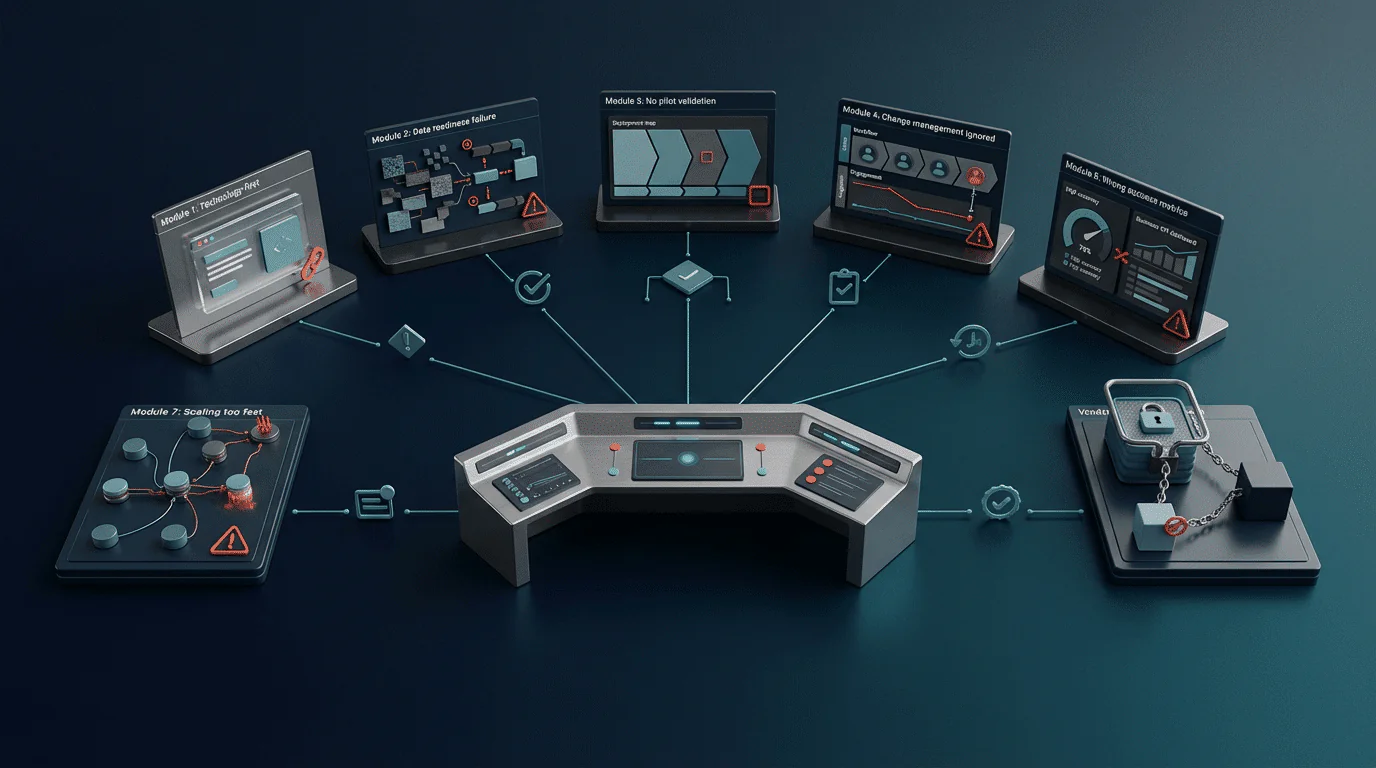

The seven most expensive mistakes in custom AI projects — from starting with technology instead of a business problem to scaling too fast before validating ROI — collectively account for the majority of the 80–95% failure rate. Yet every one of these mistakes is preventable with disciplined project governance. This article dissects each mistake, quantifies its cost, and provides the structural countermeasure that eliminates it.
Why AI Projects Fail at Twice the Rate of Traditional IT
AI projects are not just harder than traditional IT projects — they are structurally different, and the failure modes are fundamentally different. Understanding why AI fails differently is the prerequisite to preventing it.
RAND Corporation’s comprehensive analysis confirmed that over 80% of AI projects fail — exactly twice the failure rate of IT projects that do not involve AI. This is not a marginal difference; it is a categorical one. The additional failure rate is not caused by AI being more technically complex (though it is). It is caused by AI introducing failure modes that traditional IT projects do not face: data dependency (the system’s performance is determined by data quality, not just code quality), probabilistic outputs (the system produces approximations, not deterministic results), model degradation (performance declines over time as data patterns shift), and organisational resistance (AI changes how people work, not just what tools they use).
S&P Global’s 2025 survey of over 1,000 enterprises found that 42% of companies abandoned most of their AI initiatives in 2025, a dramatic spike from 17% in 2024. The average organisation scrapped 46% of AI proof-of-concepts before they reached production. Companies cited cost overruns, data privacy concerns, and security risks as the primary obstacles. Yet the companies that succeed — the outliers — do not have better technology or bigger budgets. They have better project governance. They avoid the seven mistakes documented in this article.
Each of the seven mistakes below follows the same structure: what the mistake looks like in practice, what it costs when it occurs, and the specific structural countermeasure that prevents it. These are not theoretical risks — they are patterns observed across the industry research from MIT, RAND, McKinsey, Gartner, and BCG, cross-referenced with our own implementation experience in the Benelux mid-market.
Mistake 1: Starting with Technology Instead of a Business Problem
What It Looks Like
The organisation hears about a new AI capability — perhaps generative AI, computer vision, or predictive analytics — and decides to “implement AI” without first defining which business problem it solves. The project begins with a technology demo rather than a problem definition. Stakeholders are excited about what AI can do in general without specifying what it should do for their operations specifically. The project scope is defined by the technology’s capabilities rather than by the business’s needs.
RAND Corporation identified this as the single most common root cause of AI project failure: projects falter because executives misunderstand the real problem AI is supposed to solve, set unrealistic expectations, or chase the latest technology trend without a clear business case. The result is solutions that optimise the wrong metrics or do not fit into actual workflows.
What It Costs
Technology-first projects typically consume €30,000–€80,000 before anyone discovers that the AI capability does not address a measurable business problem. The cost includes team time diverted from productive work, vendor engagement without clear scope, and the opportunity cost of not solving an actual business problem during the same period. Worse, a failed technology-first project creates organisational scepticism about AI that makes the next (correctly scoped) project harder to justify.
How to Prevent It
Require every AI project to begin with a written problem statement that includes three elements: the specific business problem to solve (e.g., “reduce demand forecast error from 18% to under 10%”), the quantified business impact of solving it (e.g., “€200,000 annual reduction in excess inventory cost”), and the metric by which success will be measured. If the project cannot produce this statement, it is not ready for AI investment. As discussed in Section 5 of this series, the Data-to-Done framework requires this problem definition as the Phase 1 deliverable — a decision gate that prevents technology-first thinking from reaching the development phase.
McKinsey’s 2025 AI survey confirms this pattern: organisations reporting significant financial returns are twice as likely to have redesigned end-to-end workflows before selecting modelling techniques. The sequence matters. Problem first, then workflow design, then technology selection.
Mistake 2: Underinvesting in Data Readiness
What It Looks Like
The project allocates 10–15% of budget and timeline to data preparation, treating it as a preliminary technical step before the “real work” of model development begins. The team discovers mid-project that data is scattered across multiple systems in inconsistent formats, with significant quality gaps, duplicate records, and missing historical periods. Data preparation consumes far more time and budget than planned, delaying model development and compressing testing and deployment into inadequate timeframes.
Informatica’s CDO Insights 2025 survey identified data quality and readiness as the number one obstacle to AI success, cited by 43% of organisations. This is not a new finding — it has been the top obstacle for years — but organisations continue to underinvest because data preparation is unsexy work that produces no visible output. The AI model is the visible deliverable; the data pipeline is invisible infrastructure that determines whether the model works.
What It Costs
Underprepared data creates three cost multipliers. First, discovery costs: the team spends unbudgeted weeks mapping data sources, documenting schemas, and assessing quality. Second, remediation costs: cleaning, deduplicating, normalising, and gap-filling data that should have been addressed before model development. Third, model rework costs: models trained on poor data produce poor results, requiring retraining on cleaned data — sometimes requiring architecture changes because the original design assumed data characteristics that did not exist. As documented in Section 7, data preparation should consume 20–30% of the project budget. Companies that allocate less than this threshold experience cost overruns of 40–60% on average.
How to Prevent It
Winning AI programmes invert typical spending ratios, earmarking 50–70% of the timeline and budget for data readiness — extraction, normalisation, governance metadata, quality dashboards, and retention controls. The structural countermeasure is a mandatory data assessment phase before model development begins. This phase produces a data quality scorecard with quantified metrics (completeness, accuracy, consistency, timeliness) and a remediation plan with timeline and cost. If data quality is below the threshold for model development, remediation occurs before any model work starts — preventing the cascading rework that destroys project budgets.
Mistake 3: Skipping the Pilot Validation Stage
What It Looks Like
The organisation attempts to deploy AI at full scale from day one — across all departments, all product lines, all geographies — without first validating the approach on a contained pilot. The reasoning is typically that a pilot “takes too long” or “doesn’t show the full potential.” The result is a large-scale deployment where problems are discovered at full scale, making them maximally expensive to fix and maximally visible to organisational stakeholders whose confidence is needed for continued investment.
Gartner predicted that at least 30% of generative AI projects would be abandoned after proof of concept by the end of 2025, specifically due to poor data quality, inadequate risk controls, escalating costs, or unclear business value. These are precisely the issues that a structured pilot phase is designed to surface — at pilot scale and pilot cost rather than at enterprise scale and enterprise cost.
What It Costs
Skipping the pilot typically costs 3–5× more than running the pilot would have cost. A €15,000–€25,000 pilot that surfaces a data quality problem or an integration challenge costs a fraction of discovering the same issue during a €150,000 full-scale deployment. Beyond the financial cost, failed full-scale deployments generate organisational trauma — the “we tried AI and it didn’t work” narrative that can delay productive AI investment by one to two years.
How to Prevent It
Mandate a contained pilot with defined success criteria before scaling. The pilot should target a single business process, a single team or department, and a defined dataset. Success criteria should be quantified (e.g., “forecast accuracy of 85% or higher on the pilot dataset”) and agreed before the pilot begins. Only after the pilot meets its success criteria does the project proceed to broader deployment. In onze ervaring, this crawl-walk-run approach — starting with a Tier 1 focused solution before expanding to Tier 2 integration — is the single most reliable predictor of long-term AI success.
Mistake 4: Ignoring Change Management and User Adoption
What It Looks Like
The technical team builds a technically excellent AI system that meets all accuracy targets and integrates cleanly with existing infrastructure. The system is deployed to production. Users do not use it. They find workarounds, revert to previous processes, or simply ignore the AI recommendations. Within six months, the system has become expensive shelf-ware — a technically impressive system that delivers zero operational value because nobody trusts or understands it.
MIT’s 2025 research found that AI initiatives stall not because of flawed algorithms but because of the people and processes surrounding them. Human factors — skills gaps, workforce resistance, and cultural barriers — compound the technical challenge. A technically perfect system that nobody uses delivers exactly zero return on investment. This is not a technology failure; it is a change management failure.
What It Costs
The cost of user rejection is the full project investment — typically €50,000–€200,000 — plus the opportunity cost of the business value that the system should have delivered. Remediation after deployment is far more expensive than prevention: rebuilding user trust, re-training with a now-sceptical user base, and potentially redesigning the user interface and workflow integration to address adoption barriers. As documented in Section 7, preventing this through adequate change management costs €5,000–€15,000; remediating it post-deployment costs €50,000–€100,000.
How to Prevent It
Allocate 10–15% of the project budget explicitly to change management: user training (both technical and workflow-level), communication materials explaining why the AI system exists and how it helps, feedback mechanisms allowing users to report issues and suggestions, pilot user involvement from the data assessment phase (creating organisational ownership), and structured rollout with progressive adoption milestones. The IMD 2025 AI Maturity Index confirms that scaling AI is as much about managing change as managing code. Budget for change management should be a line item in the proposal, not an afterthought discovered during deployment.
Mistake 5: Choosing the Wrong Success Metrics
What It Looks Like
The project team selects success metrics that are easy to measure rather than metrics that connect to business outcomes. Common examples include model accuracy (the model achieves 95% accuracy, but the business sees no operational improvement), processing speed (the system processes requests in milliseconds, but nobody uses it), or user engagement (many people log in, but nobody acts on the AI recommendations). These are technical performance metrics, not business outcome metrics. They tell you the system works technically; they tell you nothing about whether it delivers value.
This is the AI-specific manifestation of a broader measurement problem. McKinsey reports that only 1% of companies view their generative AI strategies as mature, and while 78% of companies use AI in at least one business function, nearly as many report no significant bottom-line impact. The disconnect is frequently a measurement problem: teams optimise for technical metrics while the business expects financial metrics.
What It Costs
Wrong metrics create two cascading costs. First, the project team optimises for the measured variable (e.g., accuracy) at the expense of the unmeasured variable (e.g., operational impact), producing a technically impressive system that does not deliver business value. Second, when stakeholders eventually ask “what did we get for this investment?” the team has no business-relevant data to answer the question, making continued investment impossible to justify. The project is judged a failure not because it failed technically, but because nobody measured whether it succeeded commercially.
How to Prevent It
Define success metrics at three levels before the project begins. First, business outcome metrics: the primary measure of value (e.g., cost reduction, revenue increase, time saved, error reduction) expressed in euros or hours. Second, operational metrics: the intermediate measures that drive business outcomes (e.g., forecast error rate, processing time per unit, false positive rate). Third, technical metrics: the system performance measures (e.g., model accuracy, latency, uptime). All three levels should be defined in the project charter, with explicit mapping showing how technical metrics connect to operational metrics which connect to business outcomes. If a technical metric improves but the business outcome metric does not, the project has a problem to solve, not a success to celebrate.
Mistake 6: Vendor Lock-In Through Poor IP Governance
What It Looks Like
The organisation signs a vendor contract without carefully reviewing the intellectual property and data rights clauses. The contract grants the vendor broad rights to use client data for model training, product improvement, or competitive intelligence. The trained model, data pipeline, and model weights belong to the vendor, not the client. When the client wants to switch vendors or bring the system in-house, they discover they cannot take their AI system with them — they must rebuild from scratch, losing months of work and the institutional knowledge embedded in the original system.
Stanford Law School research found that 92% of AI vendor contracts claim broad data usage rights — far exceeding the market average of 63% for SaaS contracts. Only 17% commit to full regulatory compliance, and just 33% provide indemnification for AI-generated outputs. These contractual patterns mean the default vendor position is to retain maximum control over data and IP while shifting maximum risk to the client.
The collapse of Builder.ai, once valued at $1.3 billion, exposed the harsh reality: many companies do not fully control the software and data their operations depend on. When a vendor fails, who owns your source code? What happens to your customer data? For companies that had not negotiated explicit IP ownership and data portability provisions, the answer was: rebuild from scratch.
What It Costs
Vendor lock-in creates two categories of cost. The visible cost is switching cost: if you need to change vendors, rebuilding a custom AI system from scratch costs the full original development budget plus additional cost for recreating the institutional knowledge embedded in the original system — typically 120–150% of the original investment. The invisible cost is strategic: if the vendor uses your data to improve their models which they then sell to your competitors, you have subsidised your competitors’ AI capability with your proprietary data.
How to Prevent It
Negotiate IP ownership explicitly before signing the contract. As detailed in Section 8, the IP discussion must cover four distinct assets: your input data (100% yours, no vendor training rights), the data pipeline (transfers to you), the trained model weights (yours), and the vendor’s pre-existing framework (licensed, not transferred — this is reasonable). Require a “no training, no commingling, no retention” clause for your data. Include data portability and export provisions that ensure you can migrate if needed. In onze ervaring, a partner who resists these provisions is signalling that they prioritise their own commercial interests over your strategic autonomy.
Mistake 7: Scaling Too Fast Before Validating ROI
What It Looks Like
The pilot shows promising results. Encouraged by early success, the organisation immediately scales to enterprise-wide deployment without validating that the pilot results translate to broader conditions. The scaled system encounters data sources, edge cases, integration points, and user populations that did not exist in the pilot environment. Performance degrades, costs escalate, and the organisation finds itself managing a large-scale system that delivers a fraction of the pilot’s results.
BCG’s research with 1,000 C-level executives found that 74% of companies struggle to achieve meaningful scale from AI. The majority began with successful pilots but could not translate pilot results into enterprise-level value. The problem is not that their technology did not work; the problem is that they scaled before understanding the conditions required for their technology to work.
McKinsey describes only one third of all organisations as having actually begun scaling AI across their enterprise. Everyone else is testing the waters while paying for an infrastructure they are not yet ready to use. The gap between pilot and scale is where most AI investments go to die.
What It Costs
Premature scaling typically costs 2–4× the pilot investment before the organisation recognises the problem and either pauses to fix it or abandons the effort. A €40,000 pilot that scales to a €200,000 deployment before the scaling prerequisites are in place can easily consume €300,000 before stabilising — or fail entirely. Gartner predicted that over 40% of agentic AI projects will be cancelled by end of 2027, largely due to this premature scaling pattern.
How to Prevent It
Implement a structured scaling framework with defined gates between each level. After the pilot validates the core AI capability, conduct a scaling readiness assessment that evaluates: data pipeline capacity (can the pipeline handle 10× the pilot volume?), integration robustness (are all target system integrations production-grade?), edge case coverage (has the model been tested on the full range of production scenarios?), operational support (is monitoring, alerting, and incident response in place?), and user readiness (are all target user groups trained and equipped?). Only after each readiness criterion is met should scaling proceed to the next level. The 100/25/25 rule from Section 7 applies here: budget not just for development, but for the sustained investment required to maintain and expand a production system.
The Cost Summary: Seven Mistakes at a Glance
| # | Mistake | Typical Cost | Prevention Cost | Source |
| 1 | Technology before business problem | €30K–€80K wasted | €0 (discipline) | RAND Corporation |
| 2 | Underinvesting in data readiness | 40–60% budget overrun | 20–30% budget allocation | Informatica CDO 2025 |
| 3 | Skipping pilot validation | 3–5× pilot cost | €15K–€25K pilot | Gartner |
| 4 | Ignoring change management | Full project investment | 10–15% of budget | MIT NANDA 2025 |
| 5 | Wrong success metrics | Unjustifiable investment | €0 (discipline) | McKinsey 2025 |
| 6 | Vendor lock-in / poor IP | 120–150% rebuild cost | Contract negotiation | Stanford / TermScout |
| 7 | Scaling too fast | 2–4× pilot investment | Structured scaling gates | BCG / Gartner |
The Common Thread: Governance, Not Technology
All seven mistakes share a common root cause: they are governance failures, not technology failures. No algorithm can compensate for undefined problems, unprepared data, absent change management, or premature scaling. The countermeasure for every mistake is structural — a process, a decision gate, a budget allocation — not a better model.
McKinsey’s 2025 data shows that AI high performers are 2.5× more likely to have a validation process in place. The difference between success and failure is not the fancy algorithm — it is the boring process of double-checking. High performers are actually more likely to report negative consequences from AI than other organisations, not because their AI is worse, but because they are pushing boundaries, deploying in mission-critical contexts, and learning faster because they are catching problems faster.
This is why methodology matters more than technology in AI implementation. A mature implementation methodology — such as the Data-to-Done framework described in Section 5 — builds structural countermeasures against each of these seven mistakes into the project lifecycle:
- Phase 1 (Problem Definition) prevents Mistake 1 by requiring a quantified business problem before any technical work begins.
- Phase 2 (Data Assessment) prevents Mistake 2 by surfacing data quality issues before they become model development problems.
- Phase 3 (Pilot Development) prevents Mistake 3 by validating the approach at contained scale before committing to full deployment.
- Phase 4 (Change Management) prevents Mistake 4 by ensuring user adoption is an explicit project deliverable, not an afterthought.
- Phase 1 Success Metrics Definition prevents Mistake 5 by requiring three-level metrics (business, operational, technical) before the project begins.
- Section 8 Partner Evaluation prevents Mistake 6 by requiring IP ownership negotiation before the contract is signed.
- Phase 5 (Scaling Readiness Gates) prevents Mistake 7 by requiring evidence-based readiness assessment before each scaling step.
The structural countermeasure is always cheaper than the mistake it prevents. The €0–€25,000 cost of proper governance across all seven areas is a fraction of the €100,000–€500,000 cost of even a single mistake at full scale.
AI Project Risk Assessment Checklist
Use this checklist before committing to any AI project investment. Each “no” answer identifies a risk that should be addressed before proceeding.
- Is the business problem quantified with a specific metric and euro impact?
- Is the success metric defined at business outcome, operational, and technical levels?
- Has a preliminary data assessment been conducted to identify quality and availability?
- Is at least 20–30% of the budget allocated explicitly to data preparation?
- Is a contained pilot planned before full-scale deployment?
- Are pilot success criteria quantified and agreed before the pilot begins?
- Is 10–15% of the budget allocated to change management and user training?
- Are end users involved in the project from the data assessment phase?
- Is IP ownership explicitly addressed for all four asset categories?
- Does the contract include data portability and export provisions?
- Is the post-deployment support model defined with SLAs and maintenance budgets?
- Are scaling gates defined with evidence-based readiness criteria?
- Is there a documented decision gate between each project phase?
- Has the total cost of ownership (Year 1–3) been calculated, not just development cost?
A project that answers “yes” to all fourteen questions has structural protection against all seven expensive mistakes. A project with three or more “no” answers has significant risk exposure that should be addressed before investment.
Veelgestelde Vragen
What are the biggest risks in AI projects?
The seven most expensive risks are: starting with technology instead of a business problem, underinvesting in data readiness, skipping pilot validation, ignoring change management, choosing wrong success metrics, vendor lock-in through poor IP governance, and scaling too fast before validating ROI. RAND Corporation confirms AI projects fail at twice the rate of traditional IT, and these seven mistakes account for the majority of the additional failure rate.
Why do most AI projects fail?
Most AI projects fail due to governance failures, not technology failures. S&P Global found that 42% of companies abandoned most AI initiatives in 2025, citing cost overruns, data privacy concerns, and security risks. The common thread is inadequate project governance: undefined business problems, unprepared data, absent change management, and premature scaling.
How can I prevent AI project failure?
Implement structural countermeasures at the project design phase: require a quantified business problem before technical work begins, allocate 20–30% of budget to data preparation, mandate a contained pilot before scaling, budget 10–15% for change management, define three-level success metrics, negotiate IP ownership explicitly, and implement scaling readiness gates. Each countermeasure costs a fraction of the mistake it prevents.
How much does a failed AI project cost?
A failed mid-market AI project typically costs €50,000–€300,000 in direct investment, plus the opportunity cost of the business value the system should have delivered, plus the organisational cost of delayed future AI investment due to lost confidence. The seven mistakes documented in this article collectively can turn a €100,000 investment into a €300,000+ loss.
Is it better to start with a small AI project or a large one?
MIT research found that starting small and scaling methodically succeeds at twice the rate of enterprise-wide transformation attempts. Start with a Tier 1 focused solution (€25K–€60K) solving one specific, measurable problem. Use the results to validate the business case, build organisational AI maturity, and justify the next investment. Companies that attempt Tier 3 enterprise-wide deployment as their first project face the highest failure risk.
What is the role of data quality in AI project success?
Informatica’s CDO Insights 2025 identifies data quality as the top AI obstacle, cited by 43% of organisations. Data quality is the primary determinant of AI system performance. A model trained on poor data produces poor results regardless of algorithmic sophistication. Investing in data readiness before model development is the single highest-ROI activity in any AI project.
Key Takeaways
- AI projects fail at 2× the rate of traditional IT projects — the additional failure rate is caused by governance failures, not technology failures.
- All seven mistakes are preventable through structural countermeasures: decision gates, budget allocations, mandatory phases, and contractual provisions.
- 42% of companies abandoned most AI initiatives in 2025, up from 17% in 2024 — the cost of getting AI wrong is accelerating.
- Prevention is 10–20× cheaper than remediation: €0–€25K governance vs. €100K–€500K mistake cost.
- Use the 14-question Risk Assessment Checklist before committing to any AI project investment.
- A mature implementation methodology builds structural countermeasures against all seven mistakes into the project lifecycle.
Sources
1. RAND Corporation — The Root Causes of Failure for AI Projects, 2024. rand.org
2. S&P Global / WorkOS — Why Most Enterprise AI Projects Fail, July 2025. workos.com
3. Informatica — CDO Insights 2025, March 2025. informatica.com
4. MIT Project NANDA — The GenAI Divide 2025. fortune.com
5. BCG — AI Adoption 2024: 74% Struggle. bcg.com
6. McKinsey — State of AI 2025. medium.com
7. Stanford Law School / TermScout — AI Vendor Contracts, March 2025. law.stanford.edu
8. CTO Magazine — The Great AI Vendor Lock-In, August 2025. ctomagazine.com
9. TechFunnel — Why AI Fails 2025. techfunnel.com
10. FullStack Labs — GenAI ROI: Why 80% Fail. fullstack.com
11. Jade Global — Why Your AI Project Will Probably Fail. jadeglobal.com
12. ComplexDiscovery — Why 95% of Corporate AI Projects Fail: MIT 2025. complexdiscovery.com