



A custom AI project for a mid-market company typically costs €25,000–€200,000 depending on complexity, with annual maintenance adding 15–25% of the initial investment. But cost is the wrong starting question. The right question is: what does this investment return? The answer, supported by industry data, is an average of $3.70 per dollar invested, with top performers reaching $10.30 — meaning the real risk is not the cost of building custom AI, but the cost of not building it while competitors capture that return.
Why Most AI Cost Conversations Go Wrong
The most common question potential clients ask is “How much does AI cost?” This question, without context, is as useful as asking “How much does a building cost?” — the answer depends entirely on what you are building, where, for whom, and to what standard.
AI cost conversations go wrong for three predictable reasons. First, companies compare custom AI costs to the subscription price of off-the-shelf tools, which is like comparing the cost of building a custom warehouse to the monthly rent of a shared storage unit — entirely different value propositions with entirely different return profiles. Second, companies focus exclusively on development cost (Year 1) while ignoring the total cost of ownership over three to five years, where maintenance, retraining, and scaling represent 60% or more of total expenditure. Third, companies evaluate cost in isolation rather than against the business problem the AI solves — a €75,000 fraud detection system that prevents €500,000 in annual losses is not an expense, it is an investment with a 567% return.
This article provides the transparent cost breakdown that most AI vendors avoid publishing. Every number is sourced, every range is realistic, and every hidden cost is exposed. The goal is not to make custom AI seem cheap — it is not — but to make the investment decision rational, data-driven, and free from the surprises that derail AI projects and damage trust between client and implementation partner.
Cost Breakdown by Complexity Tier
Custom AI projects fall into three complexity tiers, each with distinct cost profiles, timelines, and return expectations. The tier is determined not by ambition but by data readiness, integration complexity, and regulatory requirements.
| Tier 1: Focused | Tier 2: Integrated | Tier 3: Enterprise | |
| Investment | €25,000–€60,000 | €60,000–€150,000 | €150,000–€300,000+ |
| Timeline | 8–12 weeks | 12–20 weeks | 20–36 weeks |
| Data sources | 1–2 systems | 3–5 systems | 5+ systems |
| Integration | Standalone / API | ERP / CRM / WMS | Full stack + legacy |
| Model type | Single model | Multi-model pipeline | Multi-model + MLOps |
| Users | 1 team / dept | Cross-department | Organisation-wide |
| Compliance | Standard | Sector-specific | EU AI Act high-risk |
| Typical ROI | 3–6 months | 6–12 months | 12–18 months |
| Example | Demand forecast for one product line | Predictive maintenance across factory floor | Fraud detection integrated with claims, CRM, compliance |
Tier 1: Focused AI Solution (€25,000–€60,000)
A focused AI solution addresses a single, well-defined business problem with data from one or two existing systems. Industry benchmarks confirm that basic to mid-range AI implementations typically fall in the €25,000–€150,000 range, with focused solutions representing the lower end of this spectrum. Examples include a product demand forecasting model trained on historical sales and inventory data, a customer churn prediction model built on CRM data, or a document classification system for a specific document type. The investment covers data preparation (20–30% of budget), model development and training (25–35%), integration and deployment (20–25%), and initial testing and validation (15–20%).
Focused solutions are the recommended entry point for companies new to custom AI. They deliver the fastest time-to-value, provide a controlled learning environment for the organisation, and generate the data and confidence needed to justify larger investments. MIT research confirms that organisations starting small with tight scope scale AI pilots successfully in approximately 90 days — a timeline that aligns precisely with Tier 1 delivery.
Tier 2: Integrated AI Solution (€60,000–€150,000)
An integrated solution connects multiple data sources, serves multiple teams, and embeds AI into existing operational workflows. The cost increase relative to Tier 1 is driven primarily by three factors: data engineering complexity (integrating three to five disparate systems requires significant ETL pipeline development), cross-departmental change management (training and workflow redesign for multiple user groups), and sector-specific compliance requirements (financial services, healthcare, and manufacturing each impose additional validation and documentation requirements).
A mid-sized financial services company investing in a custom fraud detection system provides a representative cost breakdown: 22% allocated to data preparation, 28% to algorithm development, 15% to infrastructure, 18% to integration, and 17% to first-year maintenance. This distribution illustrates a critical insight: less than a third of the budget goes to the “AI” part (algorithm development). The majority funds data engineering, integration, and the operational infrastructure that makes the AI useful in practice.
Tier 3: Enterprise AI Solution (€150,000–€300,000+)
Enterprise solutions involve organisation-wide deployment, multiple AI models working in concert, full MLOps infrastructure for continuous monitoring and retraining, and compliance with high-risk AI regulations. Highly regulated industries face 20–30% higher implementation costs due to compliance requirements and specialised features. These solutions are appropriate for companies that have validated AI value through Tier 1 or Tier 2 projects and are ready to scale. Attempting Tier 3 without prior AI experience is the single most expensive mistake a mid-market company can make — it combines maximum investment with maximum organisational uncertainty.
What Actually Drives the Cost: The Five Cost Pillars
Custom AI cost is not determined by the sophistication of the algorithm. It is determined by data readiness, integration complexity, compliance requirements, change management, and ongoing maintenance. Understanding these five pillars prevents budget surprises and enables accurate planning.
Pillar 1: Data Preparation and Engineering (20–30% of Total Budget)
This is consistently the largest single cost driver and the most underestimated. Data acquisition and preparation typically account for 15–25% of total project costs, but in practice, for companies with fragmented or poorly documented data, this figure regularly reaches 30% or more. The work includes data inventory and quality assessment, data cleaning and normalisation, feature engineering (transforming raw data into model-ready inputs), ETL pipeline construction, and data governance documentation. As discussed in Section 5 of this series (Data-to-Done Framework), 70% of AI failures originate from unresolved data issues. Investing adequately in data preparation is not a cost to minimise — it is the primary determinant of whether the project succeeds or fails.
Pillar 2: Model Development and Training (20–30%)
This is the component most people think of as “the AI cost,” but it represents only a fifth to a third of total investment. The work includes model architecture selection (choosing between approaches like gradient boosting, neural networks, transformer models, or ensemble methods), training and validation, hyperparameter optimisation, bias testing, and model documentation. The cost is driven by model complexity (a single classification model vs. a multi-stage pipeline), the volume and dimensionality of training data, the number of iterations required to meet accuracy thresholds, and whether the solution uses pre-trained foundation models (lower cost) or requires training from scratch (higher cost).
A critical cost decision occurs at this stage: build vs. fine-tune vs. prompt-engineer. Building a custom model from scratch costs €50,000–€300,000+. Fine-tuning a pre-trained model costs €15,000–€75,000. Implementing an AI solution through prompt engineering on existing foundation models costs €10,000–€40,000. The right choice depends on how proprietary and domain-specific the required intelligence is — fraud detection on your specific transaction data requires custom training; a document summarisation tool may work perfectly with a fine-tuned foundation model.
Pillar 3: Integration and Deployment (15–25%)
Legacy system integration can add 25–35% to base costs, varying significantly based on existing infrastructure complexity. Integration costs are driven by the number and age of systems the AI must connect to (modern API-based systems are cheaper to integrate than legacy systems with batch processing), the required latency (real-time predictions cost more than batch processing), security and access control requirements, and whether the deployment target is cloud, on-premises, or hybrid. For mid-market companies in the Benelux, a common pattern is integration with existing ERP systems (SAP, Microsoft Dynamics, Exact), CRM platforms (Salesforce, HubSpot), and warehouse management systems. Each integration point adds €5,000–€20,000 depending on API availability and data format compatibility.
Pillar 4: Change Management and Training (10–15%)
This is the cost pillar that technical teams consistently underbudget and that business leaders consistently underestimate. Change management includes user training (both technical and workflow-level), communication materials, feedback mechanism design, workflow redesign documentation, and pilot management. The IMD 2025 AI Maturity Index concludes that scaling AI is as much about managing change as managing code. An AI system that is technically perfect but that nobody uses because the training was inadequate or the workflow integration was poorly designed delivers zero ROI. Allocating 10–15% of budget to change management is not a luxury — it is the difference between a production system and an expensive experiment.
Pillar 5: Testing, Validation, and Compliance (10–15%)
Testing and validation for AI systems is fundamentally different from traditional software testing. You are not only testing whether the system works — you are testing whether its predictions are accurate, fair, and explainable. The work includes model accuracy validation against defined success criteria, bias testing across demographic and operational segments, edge case identification and documentation, security and penetration testing, and compliance documentation. For companies in regulated sectors, the EU AI Act introduces specific requirements for transparency, auditability, human oversight, and bias testing that add to validation costs. These requirements are not optional and cannot be retrofitted cheaply — compliance-by-design during development is significantly cheaper than compliance remediation after deployment.
The Hidden Costs That Blow AI Budgets
The development cost is what appears in the proposal. The hidden costs are what appear in the budget review six months later. Understanding these before signing is the difference between a predictable investment and a financial surprise.
1. Data Remediation
If the Phase 2 data audit (described in Section 5) reveals that your critical data sources score below 70% on the Data Quality Scorecard, remediation is required before model development can begin. Data remediation can cost €10,000–€50,000 depending on the scope: deduplication, format standardisation, gap filling, and historical data reconstruction. 50–70% of AI project timeline and budget is consumed by data readiness. Companies that have invested in data infrastructure before starting an AI project save significantly on this cost. Companies that have not should budget for it explicitly.
2. Infrastructure and Compute Costs
Cloud computing costs for AI workloads are variable and can escalate rapidly during model training. A single training run for a complex model can cost €500–€5,000 in cloud compute, and multiple training iterations are standard. Production inference costs (running the model on live data) add €200–€2,000 per month depending on query volume and model complexity. These costs are often excluded from initial project proposals and presented as “client-side infrastructure costs.” A transparent AI partner includes infrastructure cost estimates in the initial proposal and designs the architecture to optimise compute efficiency.
3. Scope Expansion During Development
The single most common cause of budget overruns in AI projects is scope expansion after the project has started. This takes two forms: stakeholders add requirements during development (“can we also predict X while we’re at it?”), and the data reveals that the original problem is more complex than initially scoped. Gartner reports that 62% of supply chain AI initiatives exceed their budgets by an average of 45%, largely due to unforeseen data preparation requirements and scope expansion. The Data-to-Done framework’s Phase 1 decision gate exists specifically to prevent this — by defining the problem, success metric, and scope boundaries before any development begins, scope expansion becomes a conscious decision rather than an accidental one.
4. Model Drift and Retraining
AI models degrade over time. Customer behaviour changes, market conditions shift, product catalogues evolve, and the patterns the model learned during training become less representative of current reality. This is called model drift, and without monitoring and periodic retraining, model accuracy can decline by 20–40% annually. Retraining costs vary by model complexity but typically range from €5,000–€15,000 per retraining cycle. Most models require quarterly or semi-annual retraining. Companies that do not budget for retraining will experience declining performance that erodes ROI over time.
5. Opportunity Cost of Delayed Deployment
This is the hidden cost that never appears in any budget but may be the most significant. 88% of AI pilots never reach production. Every month of delay between project start and production deployment represents lost revenue, continued operational inefficiency, and competitive disadvantage. If a custom AI system is projected to save €200,000 annually, a three-month deployment delay costs €50,000 in unrealised savings. This is why the Data-to-Done framework targets 12–21 weeks from kickoff to production — dramatically faster than the 18-month enterprise average reported by Gartner.
Total Cost of Ownership: The Three-Year View
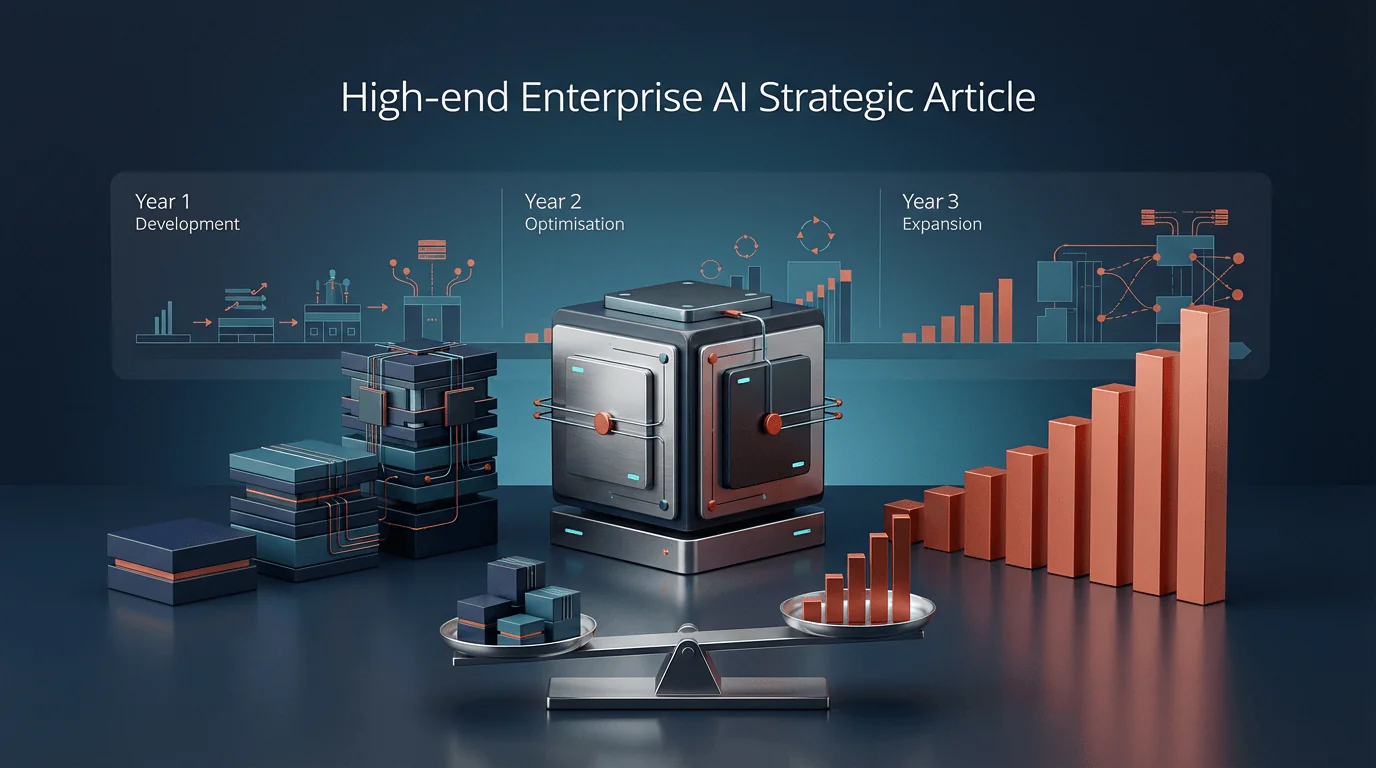
Year 1 development cost is typically 40–50% of the three-year total cost of ownership. Companies that budget only for Year 1 systematically underinvest in the maintenance, optimisation, and scaling that determine long-term ROI.
| Cost Component | Year 1 | Year 2 | Year 3 | 3-Year Total |
| Development | 100% | — | — | 100% |
| Infrastructure / Cloud | €3–15K | €3–18K | €5–25K | €11–58K |
| Maintenance & monitoring | — | 15–20% | 15–20% | 30–40% |
| Retraining (2–4x/yr) | — | €10–40K | €10–40K | €20–80K |
| Feature expansion | — | €10–30K | €15–40K | €25–70K |
| TOTAL (Tier 2 example) | €60–150K | €25–70K | €30–85K | €115–305K |
Annual AI maintenance typically costs 15–25% of initial development cost. Allocating only 10% leads to performance decline within 14 months. Allocating 20–25% enables continuous accuracy maintenance and improvement. The three-year view reveals the critical insight: custom AI is not a project — it is an operational capability that requires ongoing investment to deliver ongoing returns.
SMEs typically invest between $200,000–$500,000 implementing AI over five years, with 60% of costs arising from maintenance, training, and scaling rather than initial development. This 60/40 split between ongoing and initial costs is the most important number in AI budgeting. A company that allocates €100,000 for development and nothing for Years 2–3 will have a degrading, eventually useless system. A company that allocates €100,000 for development and €25,000 per year for maintenance will have a continuously improving competitive advantage.
The ROI Framework: When Custom AI Pays for Itself
The question is not whether custom AI delivers ROI — it does, with an industry average of $3.70 per dollar invested. The question is when. For mid-market companies following a structured implementation methodology, the typical payback period is 6–18 months.
IDC research commissioned by Microsoft found that AI investments return an average of $3.70 for every dollar invested, with top performers achieving $10.30. The difference between average performers ($3.70) and top performers ($10.30) is not the AI technology — it is the implementation methodology. Top performers define clear business metrics before development, invest adequately in data preparation, deploy structured monitoring and optimisation post-launch, and scale successful pilots methodically.
ROI Calculation by Tier
| Tier 1 | Tier 2 | Tier 3 | |
| Investment | €25–60K | €60–150K | €150–300K+ |
| Typical annual return | €50–200K | €150–500K | €400K–1M+ |
| Payback period | 3–6 months | 6–12 months | 12–18 months |
| Year 1 ROI | 150–400% | 100–300% | 50–150% |
| 3-year cumulative ROI | 500–1200% | 300–800% | 200–500% |
These return ranges are derived from sector-specific data presented in Section 6 of this series: logistics companies achieving 15–25% cost reduction, manufacturers seeing 250–300% ROI on predictive maintenance, retailers capturing 5–15% revenue lift through personalisation, and financial services achieving 95%+ fraud detection accuracy. The ranges are wide because ROI depends on the specific use case, data quality, and the business environment — but even the lower bounds represent compelling returns.
The ROI Accelerators
Four factors consistently accelerate ROI beyond the industry average:
Business-problem-first scoping. Projects that begin with a quantified business problem (“reduce inventory holding costs by 15%”) achieve faster ROI than projects that begin with a technology aspiration (“implement AI for our warehouse”). MIT research found that vendor-led implementations succeed at twice the rate of internal builds (67% vs. 33%) — the primary differentiator being this business-first discipline.
Data readiness investment. Companies that invest in data quality before model development avoid the most expensive form of rework: discovering during model training that the data is insufficient. This front-loading of effort (Phase 2 of the Data-to-Done framework) reduces total project cost by 20–30% compared to companies that discover data issues mid-project.
Narrow initial scope with expansion path. Starting with a single product line, one department, or one fraud type delivers faster time-to-value and generates the performance data needed to justify scaling. The most successful AI investments follow a crawl-walk-run pattern: Tier 1 proof of value, Tier 2 operational integration, then Tier 3 enterprise scaling.
Structured post-deployment optimisation. AI systems that are actively monitored, retrained, and optimised post-deployment deliver compounding returns. The difference between 10% and 25% annual maintenance investment is the difference between a depreciating asset and an appreciating one.
Build vs. Buy vs. Fine-Tune: The Cost-Value Decision Matrix
The build-vs-buy decision is not binary. Modern AI implementation offers a spectrum from fully custom development to fine-tuned foundation models to off-the-shelf SaaS tools — and the optimal choice depends on how proprietary your competitive advantage needs to be.
| Factor | Off-the-Shelf SaaS | Fine-Tuned Foundation | Fully Custom |
| Initial cost | €5–30K/year | €15–75K | €50–300K+ |
| Time to deploy | Days–weeks | 4–10 weeks | 12–36 weeks |
| Customisation | Configuration only | Domain-specific tuning | Fully bespoke |
| Data ownership | Vendor controls | Shared / negotiable | Full client ownership |
| Competitive moat | None (competitors access same tool) | Moderate | Maximum |
| Vendor dependency | High | Medium | Low |
| Accuracy on your data | Generic (60–80%) | Good (75–90%) | Optimised (85–95%+) |
| Long-term cost (3yr) | €15–90K | €40–150K | €115–305K |
| Best for | Commodity tasks | Domain adaptation | Core competitive advantage |
The decision framework is straightforward: if the AI capability is central to your competitive advantage (fraud detection using your data, demand forecasting incorporating your proprietary patterns, personalisation trained on your customer behaviour), build custom. If the AI capability is valuable but not differentiating (general document summarisation, standard translation, basic customer service chatbot), fine-tune or buy. The expensive mistake is building custom where off-the-shelf would suffice, or buying off-the-shelf where custom is needed to compete.
Harvard Business Review research indicates that customised AI solutions deliver 30–45% higher long-term ROI despite higher upfront investment. This premium return is driven by the competitive moat that custom solutions create: your competitors cannot purchase your proprietary AI capability. They can only build their own — which takes time, investment, and expertise that gives you a sustained advantage.
How to Budget Realistically: The 100/25/25 Rule
For every €100 invested in Year 1 development, budget €25 for Year 2 maintenance and optimisation, and €25 for Year 3 maintenance, scaling, and feature expansion. This 100/25/25 rule accounts for the full cost of ownership and ensures the investment delivers sustained returns.
Applying this rule to each tier produces realistic three-year budgets:
- Tier 1 (€40K development): €40K + €10K + €10K = €60K over three years, targeting €150–400K cumulative return.
- Tier 2 (€100K development): €100K + €25K + €25K = €150K over three years, targeting €450K–1.2M cumulative return.
- Tier 3 (€200K development): €200K + €50K + €50K = €300K over three years, targeting €600K–1.5M+ cumulative return.
The Year 2 and Year 3 budgets should be allocated as follows: 40% to model monitoring and maintenance (drift detection, accuracy reporting, security updates), 30% to retraining cycles (incorporating new data, adjusting to changed patterns, improving accuracy), and 30% to feature expansion and scaling (adding new data sources, extending to additional departments, increasing model capability). Companies that follow this allocation consistently achieve top-performer ROI levels, because they maintain and improve the asset rather than allowing it to depreciate.
The Five Most Expensive Budgeting Mistakes
These five mistakes account for the majority of AI budget overruns. Each is preventable with proper planning and a structured methodology.
Mistake 1: Budgeting Only for Development
Companies that allocate their entire AI budget to Year 1 development and nothing for ongoing operations inevitably face a choice within 18 months: invest additional unplanned budget for maintenance, or watch the system degrade. The maintenance investment is always cheaper than the retraining or rebuilding cost that follows neglect.
Mistake 2: Underestimating Data Preparation
43% of companies cite data quality as their top AI obstacle. Yet most initial project budgets allocate only 10–15% for data preparation — roughly half of what is actually required. The result is either budget overruns during development or, worse, a model trained on poor data that produces unreliable predictions in production.
Mistake 3: Skipping Change Management
A technically superior AI system that users reject, ignore, or work around delivers zero ROI. The most common reason for user rejection is inadequate training and workflow integration — problems that cost €5,000–€15,000 to prevent and €50,000–€100,000 to remediate after deployment.
Mistake 4: Choosing Tier 3 as the First Project
Companies without prior AI experience that attempt enterprise-wide deployment as their first project face the highest failure risk and the longest time to any return. 74% of companies struggle to extract AI value — and the majority of these began with overly ambitious scope. The recommended path is always Tier 1 validation, then Tier 2 integration, then Tier 3 scaling. This path costs less in total because each phase validates assumptions before the next investment is committed.
Mistake 5: Comparing Custom AI Costs to SaaS Subscriptions
A €100,000 custom AI investment and a €12,000 per year SaaS subscription are fundamentally different propositions. The SaaS tool provides generic capability available to all your competitors. The custom solution provides proprietary capability built on your data. Comparing them on price alone is like comparing the cost of leasing a shared office with the cost of building a custom production facility — they serve entirely different strategic purposes.
The Cost Transparency Checklist: What to Demand from Any AI Partner
Before signing any AI project proposal, verify that it includes transparent answers to every item on this checklist. Missing items are not oversights — they are the costs that will appear later.
- Total project cost including all phases (not just development)
- Data preparation cost estimate based on preliminary data assessment
- Infrastructure and cloud compute cost estimates (Year 1 and ongoing)
- Integration costs for each system connection, itemised
- Change management and training budget, specified
- Testing and validation costs, including compliance if applicable
- Annual maintenance cost estimate (Year 2+)
- Retraining frequency and cost per cycle
- IP ownership terms (who owns the model, the data pipeline, the trained weights?)
- Success metrics and how they will be measured
- What happens if the pilot underperforms (iteration plan, not just “more development”)
- Payment structure (milestone-based vs. time-and-materials vs. fixed price)
Any proposal that cannot answer these twelve questions is incomplete. The costs that are not disclosed upfront will be discovered during the project — and discovered costs are always more expensive than planned costs.
Veelgestelde Vragen
How much does custom AI cost for an SME?
A focused custom AI solution for an SME typically costs €25,000–€60,000 for development with an additional 15–25% annually for maintenance. A more complex, integrated solution ranges from €60,000–€150,000. The total three-year cost of ownership for a Tier 2 implementation is approximately €115,000–€305,000, with expected cumulative returns of €450K–1.2M.
What is included in AI maintenance costs?
Annual maintenance covers model performance monitoring, drift detection, scheduled retraining (typically 2–4 times per year), security updates, infrastructure management, and minor feature updates. Annual maintenance typically costs 15–25% of the initial development investment. Without adequate maintenance, model accuracy degrades 20–40% annually.
How long until I see ROI from custom AI?
Tier 1 (focused) solutions typically deliver measurable ROI within 3–6 months. Tier 2 (integrated) solutions within 6–12 months. Tier 3 (enterprise) solutions within 12–18 months. IDC data shows an average return of $3.70 per dollar invested, with top performers achieving $10.30. The speed of ROI depends primarily on how well the business problem was defined and how clean the data was at project start.
Why is data preparation so expensive?
Most companies’ data is scattered across multiple systems in different formats, with varying quality levels. Transforming this raw data into model-ready inputs requires cleaning, normalisation, deduplication, feature engineering, and pipeline automation. This data work consumes 50–70% of project timeline precisely because data quality determines model quality. Companies that invest in a data platform before starting AI projects reduce this cost significantly.
Should I build custom AI or use off-the-shelf tools?
Use off-the-shelf tools for commodity AI tasks where competitive differentiation is not required (basic chatbots, standard document processing, generic analytics). Build custom AI for capabilities that are central to your competitive advantage and that require training on your proprietary data. The deciding factor is whether your competitors can purchase the same capability — if they can, it is not a competitive advantage.
How do I prevent budget overruns in AI projects?
The three most effective budget controls are: first, rigorous Phase 1 scoping with a defined problem statement, success metric, and scope boundary (prevents scope creep). Second, Phase 2 data audit before any model development (prevents expensive data surprises mid-project). Third, milestone-based payment structure tied to defined deliverables (aligns partner incentives with client outcomes). The Data-to-Done framework’s decision gates at each phase provide natural budget checkpoints.
What is the difference between AI development cost and total cost of ownership?
Development cost covers only Year 1: data preparation, model development, integration, testing, and initial deployment. Total cost of ownership (TCO) includes the full lifecycle: development, infrastructure, annual maintenance, retraining, feature expansion, and scaling over three to five years. Development cost is typically 40–50% of three-year TCO. Budgeting only for development is the most common cause of AI investment disappointment.
Can I start small and scale up?
Yes, and this is the recommended approach. Start with a Tier 1 focused solution (€25–60K) that solves one specific, measurable problem. Use the results to validate the business case, build organisational AI maturity, and justify the next investment. MIT research confirms that organisations starting small and scaling methodically succeed at twice the rate of those attempting enterprise transformation.
Key Takeaways
- Custom AI for mid-market companies costs €25,000–€200,000+ depending on complexity tier, with annual maintenance adding 15–25% of the initial investment.
- Data preparation (20–30%) and integration (15–25%) together consume more budget than model development (20–30%) — plan accordingly.
- Average ROI is $3.70 per dollar invested, with top performers reaching $10.30. The difference is methodology, not technology.
- Total cost of ownership over three years is approximately 2–2.5× the Year 1 development cost — budget for the full lifecycle, not just the build.
- The 100/25/25 rule: for every €100 in development, budget €25 for Year 2 and €25 for Year 3 maintenance and optimisation.
- Start with Tier 1 (€25–60K, 3–6 month payback), validate, then scale — this path costs less and succeeds more often than Tier 3 first.
Sources
1. IDC / Microsoft — Generative AI ROI Report, January 2025. itpro.com
2. MIT Project NANDA — The GenAI Divide: State of AI in Business 2025. fortune.com
3. BCG — AI Adoption in 2024: 74% of Companies Struggle, October 2024. bcg.com
4. SmartDev — True Cost of Generative AI for SMEs: 5-Year Breakdown, October 2025. smartdev.com
5. Hype Studio / Medium — Custom AI Solutions Cost Guide 2025, March 2025. medium.com
6. RTS Labs — Enterprise AI Roadmap: 70% of Failures from Data Issues. rtslabs.com
7. WorkOS — Why Most Enterprise AI Projects Fail. workos.com
8. Naitive — Custom AI Models vs Off-the-Shelf: ROI Breakdown. blog.naitive.cloud
9. Tech-Stack — AI Adoption in Manufacturing: ROI Benchmarks, December 2025. tech-stack.com
10. McKinsey / Shopify — The Value of Personalisation at Scale. shopify.com
11. IMD — AI Maturity Index 2025. imd.org
12. Callin.io — Cost of Implementing AI in 2025. callin.io
13. DocShipper — How AI Is Changing Logistics & Supply Chain in 2025. docshipper.com14. European Commission — Regulatory Framework for AI (EU AI Act). digital-strategy.ec.europa.eu