





Twelve firms, twelve claims to be the obvious choice. One quotes a fixed fee, another bills hourly, a third folds software licenses into the total so the headline number looks competitive. Comparing them feels like marking exams when every candidate sat a different paper.
The risk most buyers worry about is choosing the wrong platform. That mistake is usually recoverable. The harder one to recover from is hiring someone who builds something capable and leaves you unable to change it, so that every new question becomes a change request, and every departure of their staff costs you continuity.
This is the instrument for that decision: a rubric with defensible weights, a proposal format that makes submissions comparable, a worked example showing how the scoring plays out, and the questions and tests that reveal how a firm actually works. For the wider purchase (what these services cost, how the market is structured, which contract clauses matter), see the buyer’s guide to BI consulting services.
In short: score each firm from 1 to 5 on five weighted dimensions (technical competence 25%, industry and process fit 20%, delivery track record 20%, enablement and handover 20%, team quality and continuity 15%), using the evidence the firm supplies. Leave cost out of that score; compare prices only among the firms that pass it.
The rubric in one minute

| Dimension | Weight | What you are testing | Evidence to demand |
|---|---|---|---|
| Technical competence | 25% | Depth on the platform you have chosen or shortlisted | Dated certifications; a walkthrough of a comparable build |
| Industry and process fit | 20% | Familiarity with operations like yours | Two projects in comparable operations, not comparable revenue |
| Delivery track record | 20% | Whether projects finish, on scope and on time | Completion rates, original versus actual timelines, two callable references |
| Enablement and handover | 20% | Whether your team ends up in control | Written plan: training hours, formats, documentation, independence date |
| Team quality and continuity | 15% | Whether the pitch team is the delivery team | Named people with backgrounds; substitution terms in writing |
Score each dimension 1–5 against the evidence supplied, using written anchors. Cost is deliberately excluded: the reasoning is below. Data security is not scored either: it is a pass/fail check before scoring, because nothing elsewhere should make up for a firm that cannot say how it will handle your data.
On this page
- Key Takeaways
- What business intelligence consultants actually do
- How should you weight the five dimensions?
- Why cost is not a scored dimension
- What a scored shortlist actually looks like
- How do you force proposals into one comparable format?
- What should you ask in a consultant interview?
- Red flags that should end a conversation early
- How do you design a two-week paid pilot that tells you something?
- Frequently asked questions
Key Takeaways
- Fix the weights before you meet anyone. Scoring after the meetings means scoring the impression in the room rather than the evidence in the document.
- Keep cost out of the weighted score. Clutch’s average hourly bands for BI firms run from under $25 to $100–$149 depending on the country the firm is based in, so scoring price imports a geography decision into a capability decision.
- Enablement and handover is the dimension easiest to leave unscored, because proposals describe it in adjectives. In the worked example it is worth twelve points on its own, more than the whole ten-point gap between the firm that wins the meeting and the firm that wins the rubric.
- Force every proposal into one format with identical sections in identical order. Each section exists to expose something a free-form proposal hides.
- Treat data access and security as pass/fail before scoring. A firm that cannot say what it will access, where, and how that access ends does not enter the comparison.
- Score independently with two people against written anchors for 1, 3 and 5, and compare. Divergence usually marks a proposal vague enough to be read two ways, which is itself a finding.
- A pilot is only a test if it can fail, so pick something real and currently painful rather than greenfield, and watch process rather than output.
What business intelligence consultants actually do
Think of the role as scaffolding rather than tenancy. A consultant assesses your source systems, designs a data model, builds the reporting layer, and trains your people to maintain and extend it. The scaffolding comes down when the building stands up.
The work itself is reasonably standard across firms: source-system audits, data foundation and warehouse architecture, data modeling and transformation, dashboard and report development, user training, and documentation. The US Department of Labor’s occupational profile for the role describes the analyst side of the same work, and is worth reading first because it was not written to win a deal. Where firms genuinely differ is in what they leave behind.
What a consultant should not deliver is a system only they can modify. If you cannot open it after handover (change a metric definition, add a data source, fix a broken refresh), the engagement failed, however polished the dashboards looked on the final demo.
This matters more at mid-market scale than at enterprise scale, because of staffing rather than sophistication: the system often lands with an operations manager or a finance controller who already has a full workload. That should shape the architecture you accept: simpler models, thorough documentation, training recorded so the next hire can watch it.
It is also why the rubric below gives handover a weight of its own rather than leaving it to a line in the statement of work.
How should you weight the five dimensions?
The three selection guides we read for this search in September 2026 (DataToBiz, SPD Technology, Classic Informatics) are checklists rather than scoring instruments: they list five to eight criteria and put a weight on none of them. One treats ownership handoff seriously; none turns it into a number you can compare across bids. An unweighted checklist leaves the weighting to whoever is in the room, and the criterion that decides whether the work survives on someone’s already-full desk is rarely the most vivid part of a pitch.
The weights in the table above put enablement at 20%, equal to delivery track record. For an organization with a standing analytics function, 5% might be enough. Where the operations director owns the dashboards from launch onward, it deserves the same weight as whether projects finish at all.
Survey evidence points the same way, if indirectly. In September 2026, Gartner reported that in a survey of 223 data and analytics leaders in March 2026, cultural resistance outweighed funding constraints as the primary reason governance initiatives fail: 60% against 40%. Anurag Raj, Director Analyst at Gartner, put it plainly: “Data governance without a focus on a data-driven culture is an effort in vain.”
The survey is about data governance, not BI consulting, and it does not validate a 20% weight. What it supports is treating adoption as a risk that needs evidence in the proposal rather than an assumption about what happens after go-live. A firm that treats adoption as your problem (something that happens after their scope ends) is leaving out the part those respondents named as the primary reason governance programs fail. Ask how they handle the operations manager who does not trust the new number because it disagrees with the spreadsheet she has maintained for six years, and expect a method and an example rather than reassurance.
Gartner’s April 2026 research adds a second, equally indirect signal: organizations reporting successful AI initiatives invest up to four times more, as a percentage of revenue, in foundations such as data quality, governance, AI-ready people and change management than those reporting poor AI outcomes. It compares organizations and shows association, not cause, but the categories it names are the ones proposals tend to under-scope.
Industry fit is easy to misread. It is not about sector labels but about whether the firm has modeled comparable processes: a consultant who has built operational reporting for a manufacturer will ramp faster on a production floor than a generalist with a larger logo wall.
Delivery track record needs one adjustment, because its obvious evidence is the weakest. Across 5,392 IT projects, Flyvbjerg and colleagues found cost overruns follow a power-law distribution: many projects overrun a little, and a fat tail overruns by a great deal. An average computed across that shape says little about your exposure. The study did not test supplier interviews, but its practical lesson is to look at the tail: ask for the worst overrun in the last three years, its cause, and what changed afterwards. A firm that cannot remember one has either not delivered enough work or is not telling you.
These are starting weights, not a validated benchmark. Move five points between dimensions if your situation differs: to technical competence where an internal BI lead exists, the other way where you are replacing a failed implementation. If moving five points between the two dimensions you are least sure about changes the winner, the decision is closer than the totals suggest; gather more evidence before choosing. What matters is that the weights, and the pass mark, are fixed before you meet anyone.
Why cost is not a scored dimension
Score fit first and compare cost only among firms that clear a quality threshold fixed with the weights. A reasonable starting point is at least 350 of 500 with no dimension below 2; in the worked example below, that takes Firms A and B to the cost comparison and leaves Firm C out. Folding price into a weighted score lets an inexpensive poor fit beat an appropriate one on arithmetic, and the arithmetic will look objective while doing it.
There is a second reason, specific to this category. Clutch’s pricing guide (updated 21 September 2026) gives average hourly bands for BI and data analytics firms from under $25 in the Philippines to $100–$149 in the United States, Canada and Australia. They are bands for firms listed on one platform, not audited market rates, but the top band starts at four times the ceiling of the bottom one. A rate that looks like a bargain often reflects where the firm is based rather than how well it delivers. Scoring it as though it were a quality signal imports a geography decision into a capability decision. The buyer’s guide works through what actually drives those differences.
Handle cost as a second pass, and compare totals rather than rates. For the same scope, add up fees at the proposed team mix and hours from Section B, licenses and infrastructure where included, travel, support after go-live, the terms for change requests, and VAT and currency. Note who carries the risk if the estimate slips; Section C shows it. Only then ask whether the price difference between your top two is justified by anything you can name.
What a scored shortlist actually looks like
Two people scoring the same proposal need a shared definition of each score. These illustrative anchors are the ones the worked example uses; adapt the wording, fix it before proposals arrive, and treat 2 and 4 as the points between.
| Dimension (weight) | 1 | 3 | 5 |
|---|---|---|---|
| Technical competence (25%) | Platform claims, no dated certifications, no comparable build to show | Dated certifications, or a comparable build described but not shown | Dated certifications held by the people who will deliver, plus a walkthrough of a comparable build |
| Industry and process fit (20%) | No work in your sector or in comparable operations | One project in comparable operations | Two or more projects in comparable operations, described in enough detail to check |
| Delivery track record (20%) | No completion data and no callable references | References or completion data, not both | Original versus actual timelines, the worst overrun explained, two callable references |
| Enablement and handover (20%) | No written enablement plan | Training hours, formats and documentation listed, but no independence date | All of that, plus a date by which your team runs the system without them |
| Team quality and continuity (15%) | No named people | Named delivery team, but not the people who pitched, or no substitution terms | The people who pitched are the named delivery team, with substitution terms in writing |
When evidence is mixed, trust what you can check and hold the firm to: named staff, dated certificates, redacted documents, contract terms, callable references, over logos, undated case studies and demos by people who will not do the work.
Worked examples are more useful than rubrics, because the interesting cases are the ones where the totals disagree with the room. Here are three firms scored against those anchors, weighted as above.
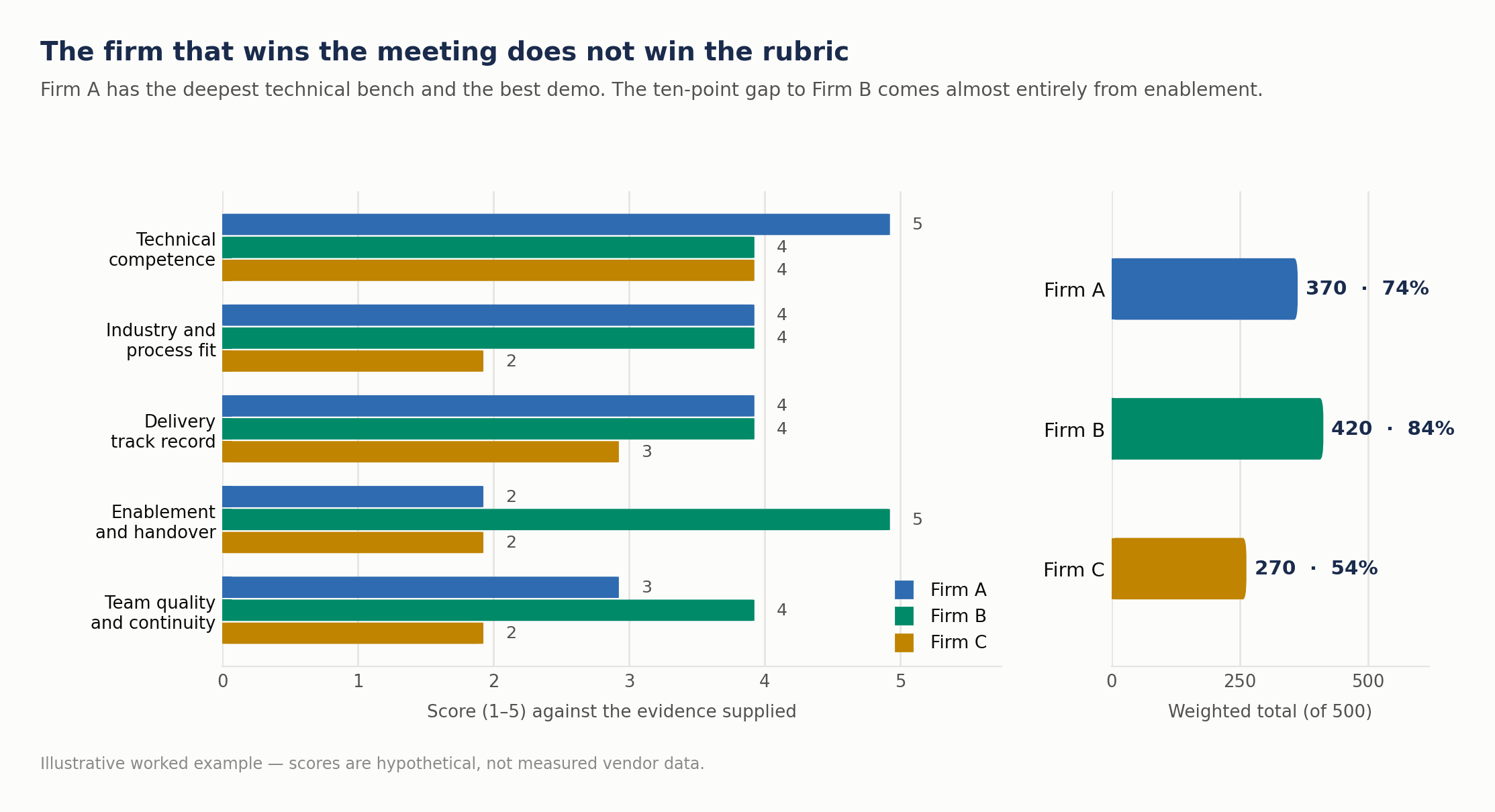
| Dimension | Weight | Firm A | Firm B | Firm C |
|---|---|---|---|---|
| Technical competence | 25% | 5 | 4 | 4 |
| Industry and process fit | 20% | 4 | 4 | 2 |
| Delivery track record | 20% | 4 | 4 | 3 |
| Enablement and handover | 20% | 2 | 5 | 2 |
| Team quality and continuity | 15% | 3 | 4 | 2 |
| Weighted total (of 500) | 370 | 420 | 270 | |
| Percentage | 74% | 84% | 54% |
Firm A is the one that wins the meeting. It has the deepest technical bench, the most impressive reference logos, and the demo everyone talks about afterwards. It also scores 2 on enablement, because its proposal describes training as “comprehensive” without attaching hours, and 3 on continuity, because the two people who presented are not the people who would deliver.
Continuity earns a scored line rather than a polite question for an economic reason. Day rates rise steeply with seniority: the German consultancy association BDU’s 2025 fee study puts the average billed day at €1,600 for a partner or managing director against €700 for an analyst, across consulting generally rather than BI alone, so where the price was built on senior days, every senior name swapped for a junior one after signature widens the supplier’s margin on the same invoice. Not an accusation: the incentive the contract has to answer, and the reason substitution terms belong in writing.
Firm B wins on the rubric without winning the room. Slightly less technical depth, an equal delivery record, and the only enablement plan of the three with dates and named hours in it.
Firm C is the cheap option, and the scoring shows why cheap was the wrong frame. Its weakness is not price but fit: sector experience but no comparable operations, a thin delivery record, and the same enablement gap as Firm A.
The arithmetic of the ten-point gap between A and B: enablement alone is worth twelve points to Firm B, continuity adds three, and Firm A’s technical edge wins back five. Firm A is not a bad firm; its strengths are concentrated in the phase that ends, and its weakness in the phase that decides whether the work survives. The result also passes the five-point test: the move most favorable to Firm A, five points from enablement to technical competence, narrows the gap to six points (385 against 415) without changing the order.
Run this with two people scoring independently and compare. Divergence usually points at a section where a proposal was vague enough to be read two ways, which is itself a finding.
How do you force proposals into one comparable format?
Proposals differ because you let each firm choose the format. Take that choice back.
Issue one request to your shortlist requiring identical sections in identical order. Each section exists to expose something a free-form proposal hides:
Proposals differ because you let each firm choose the format. Take that choice back.
| Section | What you require | What it reveals |
|---|---|---|
| A. Scope confirmation | Restate your requirements; ask them to confirm, amend or flag gaps | The amendments show who actually read it |
| B. Deliverable breakdown | Every deliverable priced separately, with an effort estimate in hours | Where the money goes, and under-scoped enablement |
| C. Pricing, three ways | The same scope as fixed fee, capped time-and-materials, and retainer | How each firm thinks about who carries the risk |
| D. Team and timeline | Named people, availability, working hours and time zone, week by week | Whether ‘a senior consultant’ is the whole answer |
| E. Enablement plan | Training hours and formats, documentation, an independence date | Whether ownership transfer is designed or improvised |
| F. References | Two contacts at businesses comparable in size and complexity | Whether the track record survives a phone call |
| G. Data access, security and exit | Data and systems needed, subcontractors, access controls, exit terms | Whether you can trust them with access (pass/fail, not scored) |
Section E is the tell. Score it from the evidence supplied: no hours written down means it scores 2, however well it was discussed.
Conceptual framework, not a data chart.
Section A: Scope confirmation. Restate your requirements in your own words and ask each firm to confirm, amend, or flag what you have missed. The amendments are the useful part; they show who read it.
Section B: Deliverable breakdown. Every deliverable listed separately with an effort estimate in hours and a price. Firms preferring a fixed fee still complete this. It shows where the money goes and makes under-scoped enablement visible.
Section C: Pricing, three ways. The same scope as a fixed fee, as capped time-and-materials, and as a monthly retainer. You will use one. Seeing all three shows how each firm thinks about who carries the risk when estimates slip.
Section D: Team and timeline. Named individuals, roles, availability percentages, working hours and time zone, and a week-by-week plan. “A senior consultant will be assigned” scores 1 on continuity.
Section E: Enablement plan. Number of training sessions and hours, format for each, documentation deliverables, and a date by which your team runs the system without them present.
Section F: References. Two contacts at businesses comparable in size and complexity. People, not logos. The firm will pick its happiest clients, so ask each the same things: what changed from the original scope, which milestone slipped, what the client had to supply, what still depended on the consultant after handover, and whether the pitch team did the work.
Section G: Data access, security and exit. The systems and data the team needs; where the data will be processed and by whom, including subcontractors; how privileged access is approved and logged; how incidents are reported; how access and copies are removed at the end; and who owns the code, models and documentation. Section G is not scored. It is the gate: a firm that cannot answer it clearly does not enter the weighted comparison. Where the work touches personal data and the GDPR applies, the firm will usually be your processor, and Article 28 requires a written contract covering, among other things, confidentiality, security, sub-processors and deletion or return of the data at the end.
Add one instruction above Section A: name the engagement shape and its duration before anything else. Firms that publish fixed shapes make this trivial: ours are a 2–4 week Discovery, a 2–6 month Transform and a 6–18 month Enterprise engagement, set out on the packages page, and a firm that cannot say whether it is proposing four weeks or four months has not scoped the work yet.
With every submission following the same skeleton, scoring becomes close to mechanical, provided you score from the evidence supplied rather than the impression created. If Section E contains no hours, enablement scores 2 however convincingly the topic was discussed in the meeting. That is how the rubric stops a good presenter from outscoring a good delivery team.
What should you ask in a consultant interview?
Capability decks are rehearsed. These questions are harder to rehearse, because the useful part of the answer is specific.

Capability decks are rehearsed. The useful part of each answer below is specific enough that it cannot be.
Question six sounds like a pleasantry. Gartner’s survey on why governance fails is a reason to score it.
Conceptual framework, not a data chart.
“Which platform would you not recommend for our situation, and why?” A reasoned answer shows judgment. A diplomatic non-answer shows a sales process.
“Walk me through a project that went badly.” Any firm with a real delivery history has one. The firms worth hiring describe what they misjudged and what they changed. Firms that blame the client on the first attempt are likely to blame you on the second.
“Who maintains this in eighteen months, and what happens when they leave?” This tests whether they have thought past go-live. Listen for documentation and recorded training rather than reassurance.
“Show me the documentation from a comparable project.” Redacted is acceptable. Documentation is easy to promise and hard to check before signature, and a real example tells you what “documentation included” means to this particular firm.
“What would you need from us for this to work, and what happens if we cannot provide it?” Good consultants have requirements: data access, a decision-maker who responds, time from the people who understand the source systems. A firm claiming to need nothing from you has not thought it through. Follow up on access: on a comparable engagement, which environments could the team reach, who approved privileged accounts, did subcontractors see the data, and what evidence did the client get when access ended?
“How do you handle it when a stakeholder does not believe the numbers?” The Gartner finding above is a reason to score this rather than treat it as a pleasantry. Trust is the mechanism by which dashboards become used or abandoned.
Where delivery spans time zones, add one more: “Which hours overlap with ours, and which phases need that overlap?” Distributed delivery tends to suit build phases better than discovery, and a firm that has done it well will usually say which phases it keeps close.
Red flags that should end a conversation early
Not every weakness disqualifies. A firm without experience in your exact sub-sector may still be right if the method is sound. These five, though, are serious enough to end the conversation early.
Not every weakness disqualifies. These five are serious enough to end the conversation.
A sixth is harder to name because it looks like enthusiasm: a firm that agrees with everything.
Conceptual framework, not a data chart.
| Red flag | What it usually means |
|---|---|
| Dashboard design discussed before data quality | The foundation is being skipped; the discovery happens later, in front of an executive audience |
| Enablement described in adjectives, not hours | Dependency is being designed in, whether or not anyone intends it |
| Reluctance about any paid, bounded test | The commercial model may need large contracts to be viable; a firm with a stated reason should offer another way to test delivery |
| One platform recommended for every problem | You are being sold their comfort zone; it may still fit, but establish which it is |
| Ownership or data-handling questions deflected to “the contract phase” | Settle IP, data portability and access terms now, while you still have leverage |
A sixth is harder to name, because it looks like enthusiasm: a firm that agrees with everything. Buyers often read agreement as good fit. In a discipline where the most valuable early contribution is telling you that your reporting question is the wrong question, total agreement is closer to a warning.
How do you design a two-week paid pilot that tells you something?
A pilot only works as a test if it can fail. Many cannot, because they are scoped as demonstrations.
Pick a problem that is real, contained, and currently painful: a report someone rebuilds by hand every week, a number two departments calculate differently, a reconciliation that eats a day each month. Operational reporting tends to offer the best candidates, because the pain is measurable and the data is already being touched daily. Avoid anything greenfield. You are not testing whether they can build something attractive; you are testing how they behave when your data is messier than they expected.
Define four things in writing before it starts:
Pick a problem that is real, contained and currently painful. Avoid anything greenfield.
Then watch process, not output
- How did they respond when a field turned out to be unreliable?
- Did they ask your people questions, or work around them?
- Did documentation appear because you asked, or by default?
- Did they tell you something you did not know about your own data?
The last one is a useful signal, but not a pass criterion.
Conceptual framework, not a data chart.
| Element | What to specify |
|---|---|
| The question | One decision the pilot should make faster, stated in a sentence |
| The data | Which systems and fields, masked where possible; who has access, and until when |
| The deliverable | What exists at the end, including documentation, however small |
| The verdict | Who judges it, against which pass/fail checks, on what date |
A real problem does not need unrestricted real data. Use the least sensitive data that still tests the work, such as a masked extract or a restricted non-production copy, with time-limited, least-privilege accounts revoked when the pilot ends. If personal data is involved, the Section G contract applies to the pilot too. A firm that asks for broad production access before explaining any of this is showing you how it will treat your data later.
Write the verdict as checks that can fail: the numbers reconcile to an agreed baseline, the refresh completes within an agreed window, someone on your team makes a defined change using only the documentation, and open risks are listed in writing.
Then watch process rather than output. How did they respond when a field turned out to be unreliable? Did they ask your people questions, or work around them? Did documentation appear because you asked, or by default?
One more signal is worth watching, though not as a pass criterion, because sound work on clean data may turn up nothing new: whether they told you something you did not know about your own data. A firm that surfaces an uncomfortable finding in two paid weeks (that two systems disagree, that a metric has been calculated wrongly for a year) is showing you exactly what working with them is like. A firm that delivers a clean dashboard and no observations on messy data has told you something too.
Whoever you run it with, insist that the output is usable on its own rather than being a proposal for the next phase.
Frequently asked questions
How many consultants should we shortlist?
As a practical default, three or four for detailed scoring, from a longlist of six to eight filtered on certifications and sector fit; procurement rules or a thin market may justify more or fewer. Scoring twelve properly takes longer than many buyers can sustain, and a rushed rubric is worse than an honest gut call because it dresses the guess in numbers.
Should we hire an individual freelancer or a firm?
It depends which risk you would rather carry. A capable individual often delivers better value on a contained build; a firm carries continuity when someone leaves mid-project. If you go with an individual, the continuity question moves into your contract: documentation standards and a named backup become more important, not less.
What if we do not know which platform we want yet?
That is a normal position and a reasonable thing to buy advice about, provided you buy it separately. A short platform-selection engagement, priced on its own, keeps the recommendation honest. Bundling tool selection into an implementation contract gives the same firm an interest in the answer.
How do we score a firm with strong references but no experience in our sector?
Score industry fit low and technical competence and method on their merits, then see whether the total clears your bar. Sector experience shortens the ramp; it does not substitute for method. A firm that has never worked in professional services but understands utilization reporting is likely to outperform a sector specialist with weak delivery discipline.
Can we use this rubric for an offshore or distributed team?
Yes, with one change: score team continuity on documented working-hours overlap rather than on location, and weight it slightly higher if discovery will run remotely. The dimensions hold; what varies is how you gather the evidence for the last one. Section G matters more here, since it records in which countries your data will be processed.
When should we walk away from all of them and start again?
When no candidate can fill in the enablement section with specifics. That usually means the shortlist was drawn from firms with the same commercial model, and the fix is a different longlist rather than a harder negotiation.
If you only do one thing
Fix the weights before you meet anyone, and score from the evidence in the document rather than the impression in the room.
That single discipline produces the result the worked example shows: the firm with the best demo does not automatically win, because the dimension it is weakest on is the one that determines whether anything survives the handover.
If you already have submissions in hand, a structured review against fixed weights can surface the gaps before you commit. If the harder part is Section A, because what your current reporting does and where it falls short has not been written down, that is what a two-to-four-week look at your current reporting and its gaps produces: a current-state and gap assessment, quick-win recommendations and a prioritized roadmap you can hand to every firm on the shortlist. To talk through where you are in a selection, start with a note on the shortlist.
Independence note: Veralytiq has no commercial relationship with any vendor named in this article.
Related Articles
- Business Intelligence Services: What to Expect in 2026 — An overview of business intelligence services
- BI Strategy & Roadmap: A Complete Guide for Dutch Mid-Market Companies — Frameworks, roadmaps and tools to turn data into decisions
Sources
Analyst research
- Gartner, 60% of Organizations That Ignore Data Governance Culture Challenges Will Fail to Govern AI Successfully by 2027, 21 September 2026. Survey of 223 data and analytics leaders, March 2026.
- Gartner, Organizations with Successful AI Initiatives Invest Up to Four Times More in Data and Analytics Foundations, 16 April 2026. Survey of 353 data, analytics and AI leaders, November–December 2025.
Peer-reviewed
- Flyvbjerg, Budzier, Lee, Keil, Lunn & Bester, The Empirical Reality of IT Project Cost Overruns: Discovering A Power-Law Distribution, Journal of Management Information Systems 39(3), 2022, pp. 607–639. 5,392 IT projects; an author’s clarification (2023) documents the subsample used to fit the tail.
Regulation
- European Union, Regulation (EU) 2016/679 (General Data Protection Regulation), Article 28: Processor.
Official statistics
- O*NET / US Department of Labor, 15-2051.01: Business Intelligence Analysts. Occupational task profile.
Selection guides reviewed for the framework comparison (read September 2026)
- DataToBiz, How To Choose the Right Business Intelligence Consultant?
- SPD Technology, Business Intelligence Consulting Companies Review: Factors of the Highest Impact
- Classic Informatics, Business Intelligence Consulting: How to Choose the Right Partner
Professional association survey (sample size not stated on the linked page)
- BDU (Bundesverband Deutscher Unternehmensberatungen), Honorare im Consulting 2025, press release, 15 December 2025. Average billed day rates: €1,300 overall, €1,600 partner or managing director, €700 analyst.
Rate data (commercial platform; methodology not independently audited)
- Clutch, Business Intelligence & Data Analytics Pricing Guide 2026, updated 21 September 2026. Average hourly bands by firm location.